
Medical Device CNC Machining
Medical device work has the largest gap on this site between "we can machine that part" and "we can machine that part for a regulated device". The gap is paperwork, traceability, and material discipline — not capability with the spindle. A shop that quotes a Ti-6Al-4V implant component the same way it quotes a 6061 bracket is telling you what kind of supplier it actually is.
For OEM medical and dental device programs, the questions on our side of the conversation are the questions a regulated buyer should be asking: which ASTM grade, which heat treat condition, which sterilization method survives the cycle, and which lot certification follows the part to the receiving dock.
What we handle
- Implant components, surgical instruments, dental hardware, drug-delivery parts, and diagnostic instrument bodies on OEM and prototype releases.
- Medical-grade titanium, stainless, cobalt-chrome, and implant PEEK — sourced against the ASTM spec your drawing names, with mill cert lots retained.
- Full process scope from material sourcing through inspection records, with ISO 13485-controlled production for device programs and clean handling for parts headed to sterile assembly.
Why medical device CNC is more about paperwork than tool paths
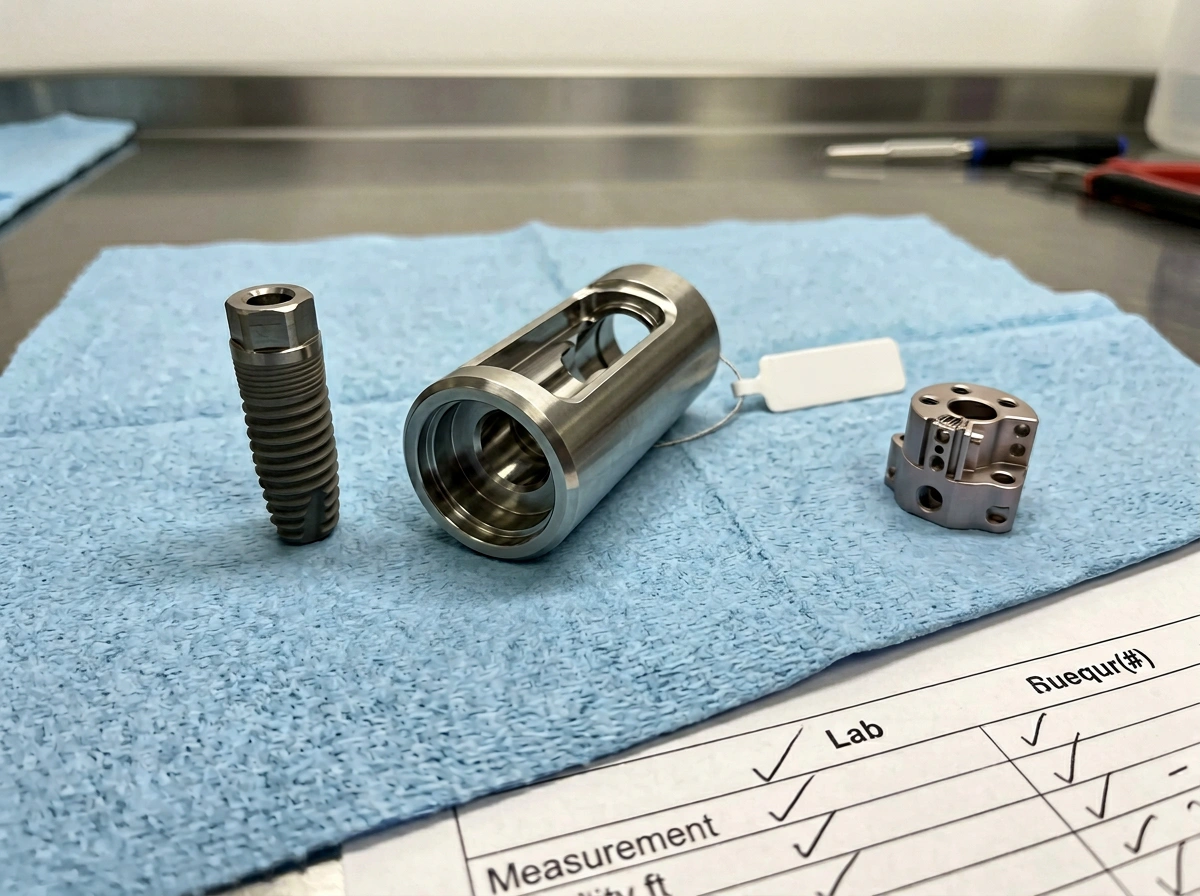
The cutting itself rarely separates a competent shop from an incompetent one on a medical part. The thing that separates them is what happens before and after the cut: which mill cert came in with the bar stock, what condition the alloy was supplied in, which inspection records ship with the carton, whether the part was handled with gloves and packaged in the right barrier, and whose name is on the certificate that the device manufacturer hands to the auditor six months later.
Practically, every medical RFQ that lands here has three answers we need before we can quote: the ASTM material spec on the drawing, the sterilization method the finished device will see, and the device's patient-contact class. Those three answers shape everything downstream — stock source, routing, fixture cleanliness, packaging, and the records that ship with the lot.
Sterilization compatibility by alloy — the conversation that drives the quote
A medical device drawing is not done until the sterilization method is on it. The matrix below shows how the alloys we machine for medical work hold up against the four sterilization cycles that turn up most often. Use it to rule grades in or out before locking the BOM.
| Material | Steam autoclave | Gamma irradiation | Ethylene oxide (EtO) | Hydrogen-peroxide plasma |
|---|---|---|---|---|
| Ti-6Al-4V (Grades 5 & 23) | Excellent — repeated cycles, no degradation | Excellent | Excellent | Excellent |
| 316L stainless | Excellent — the workhorse of reusable surgical instruments | Excellent | Excellent | Excellent |
| 17-4 PH stainless | Good in solution-treated condition; verify heat treat against the spec | Excellent | Excellent | Good |
| CoCrMo (ASTM F75 / F1537) | Excellent | Excellent | Excellent | Excellent |
| Implant-grade PEEK | Good — repeated cycles can affect dimensional stability over time | Limited — gamma can degrade some PEEK formulations; check the supplier datasheet | Excellent | Good |
| Aluminum 6061 (non-implant only) | Limited — repeated steam exposure pits the surface over time | Excellent | Excellent | Excellent |
The matrix is a planning tool, not a compatibility certificate. Specific behaviour depends on the supplier's grade, the heat treat condition, the surface finish, the cycle parameters, and the device's intended use. Name the sterilization method on your drawing and we will confirm the stock source against it before cutting starts.
Medical-grade materials we machine
A short list of the alloys and polymers that turn up on most medical RFQs that land here. Each card names the ASTM specification, because "medical-grade titanium" without a spec number is not a procurement instruction.
Ti-6Al-4V Grade 5 (ASTM F1472)
The titanium workhorse for surgical instruments, dental hardware, and non-implant medical components. Strong, biocompatible, corrosion resistant in body chemistry, and supported by every major sterilization route.
Ti-6Al-4V Grade 23 ELI (ASTM F136)
The extra-low-interstitial implant grade. Lower oxygen and iron content than Grade 5 gives improved fracture toughness for orthopedic and spinal implants where the device sees long-term cyclic load.
316L stainless (ASTM F138)
The reusable-surgical-instrument default. Low-carbon austenitic stainless with the corrosion resistance and sterilization tolerance to survive thousands of autoclave cycles without pitting at the cut surfaces.
17-4 PH stainless (ASTM F899)
Precipitation-hardening stainless used where instruments need higher strength than 316L can provide — needle holders, scissors, and load-bearing surgical hardware. Heat treat condition (H900, H1025, etc.) drives both cutting and final properties.
CoCrMo (ASTM F75 / F1537)
Cobalt-chromium-molybdenum alloy for orthopedic implants, joint replacement components, and dental framework structures. Wear resistance and biocompatibility unmatched by stainless steels in long-term implanted applications.
Implant-grade PEEK
Radiolucent, biocompatible thermoplastic for spinal cages, trauma fixation, and other implant components where a polymer is preferred over metal. Specify the supplier-graded medical formulation explicitly — generic PEEK is not the same product.
For non-medical work in these grades and the broader engineering material list, see metal machining and plastic machining; the underlying milling and turning operations are documented on the CNC milling and CNC turning pages.
Titanium and CoCrMo: why the schedule reflects the alloy, not just the geometry
Ti-6Al-4V, Grade 23 ELI, and CoCrMo are named on this page because we cut them regularly — but "we cut it regularly" isn't the same as "it cuts the same as everything else." Here's what actually changes when the material callout on the drawing switches from 6061 to a medical alloy.
Titanium's low thermal conductivity is the root of most of it. Heat generated in the cut has nowhere to go but into the tool, so tool-chip interface temperatures run higher on titanium than on most other metals cut at the same tool stress. Cutting speed is one of the most critical variables in the whole operation as a result — push it too far and tool-chip temperature spikes, tool life drops sharply, and speeds get held to comparatively low values unless the setup delivers real cooling. A cutting fluid on titanium isn't a housekeeping step; it extends tool life, improves surface finish, cuts down on tool-to-workpiece welding, and reduces residual stress in the finished part, and it earns its keep by being directed as close to the point of cut as the setup allows.
Titanium's low elastic modulus adds a second variable: the part deflects more than a steel or aluminum part would under the same cutting force, which is a fixturing and rigidity question as much as a speeds-and-feeds one. And the tool has to keep moving — letting a tool dwell in contact with titanium rather than maintaining continuous feed promotes work hardening at the contact point, along with smearing, galling, and seizing that can take the edge out fast. Commercially pure titanium actually machines a lot like 18-8 stainless; the structural alloy grades used in implant and instrument work are simply harder, and the basic requirements stay the same across the board — a rigid setup and a cutting fluid that's actually doing its job, not exotic tooling.
CoCrMo is a different problem with the same symptom. It sits with the cobalt- and nickel-base superalloy family — materials abrasive enough that they're grouped with gray cast iron among the metals that shouldn't be run with uncoated titanium-carbide tooling. Tooling choice for CoCrMo is its own decision, not an extension of whatever's already dialed in for stainless or aluminum. And on the stainless side already named on this page, 316L work-hardens under light or interrupted cuts the way most austenitic stainless does, while 17-4 PH's actual cutting behavior — and its final mechanical properties — depend on which heat-treat condition (H900, H1025, and so on) the stock was supplied in. See how we cut stainless steel for the broader stainless picture.
| Alloy | Dominant machining challenge | What it means for the schedule |
|---|---|---|
| Ti-6Al-4V Grade 5 / Grade 23 ELI | Low thermal conductivity concentrates heat at the cutting edge; low elastic modulus increases deflection under load | Lower cutting speeds, rigid fixturing, continuous coolant directed at the cut, no dwelling with the tool engaged |
| CoCrMo (ASTM F75 / F1537) | Classed with abrasive, hard-to-machine superalloys; not suited to uncoated carbide tooling | Tooling selection is alloy-specific, not carried over from steel or aluminum programs; tool life planned per lot |
| 316L stainless | Austenitic — work-hardens under light or interrupted cuts | Continuous engagement and consistent feed favored over light finishing passes |
| 17-4 PH stainless | Cutting behavior and final properties both depend on heat-treat condition | Condition (H900 / H1025 / etc.) confirmed against the drawing before cutting parameters are set |
What happens to the surface after the cut: passivation and electropolishing
Two surface treatments turn up on a large share of real stainless and titanium medical RFQs, and neither is a mystery step — both are standards-governed, and both do a specific, different job.
Machining a stainless part can embed free iron and other foreign particles into the surface's high points. Passivation is the chemical step that removes that surface iron so the chromium-oxide passive layer — the thing that actually gives stainless its corrosion resistance — can reform cleanly across the whole part, not just the areas that look shiny. QQ-P-35C, the reference specification most shops still build their passivation process against, sets the bath's acid concentration, temperature, and immersion time by treatment type: ambient-temperature nitric-acid baths typically run around 30 minutes in the 70–90°F range, while elevated-temperature variants run 20–30 minutes at 120–150°F, with the exact concentration and any dichromate addition set by grade. 200-, 300-, and 400-series stainless and precipitation-hardened corrosion-resistant grades — which covers both 316L and 17-4 PH, already named on this page — all fall under this passivation scope, with the result typically verified per MIL-STD-753. Free-machining grades, or grades where cutting-tool material may be embedded rather than just surface iron, sometimes call for a different nitric-acid/sodium-bichromate bath at its own time and temperature — passivation chemistry is grade-specific, not a single universal dip.
Electropolishing is a distinct, further step. It electrolytically removes or reduces scratches, burrs, and sharp edges, and can be expected to lower measured surface roughness (Ra) by roughly 10–35%, with as much as 50% improvement possible in favorable cases. Beyond the finish itself, it improves both corrosion resistance and fatigue life by eliminating microscopic surface defects, and it passivates the exposed surface as a side effect of the process — the mechanism is a viscous film that forms during electropolishing and dissolves metal faster at the microscopically high points than at the low points, which is what does the smoothing and rounding. Name the standard (ASTM A967 for passivation, ASTM B912 for electropolishing) and the target finish on the drawing, and the quote confirms how the spec gets met before cutting starts.
| Treatment | What it does | When a medical RFQ typically calls for it |
|---|---|---|
| Passivation (ASTM A967 / QQ-P-35) | Chemically removes free iron and embedded particles so the chromium-oxide passive layer reforms across the whole part | Near-default on reusable 316L and 17-4 PH surgical instruments and on stainless implant components |
| Electropolishing (ASTM B912) | Electrochemically removes high points; typically lowers Ra by roughly 10–35%, occasionally more; also passivates the surface as a side effect | Specified when the drawing calls for a smoother finish than passivation alone delivers, or when fatigue/corrosion performance is a stated design requirement |
Verification your auditor can actually use
On a medical device part, "it measures good" is not enough. The inspection record, the material certificate tied to an ASTM grade, and the lot traceability that follows the part to the receiving dock all have to reconcile with the drawing and the PO. Otherwise receiving flags the lot, the device manufacturer's auditor asks an uncomfortable question six months later, and the schedule slips in both directions. The cutting rarely separates a competent shop from an incompetent one on a medical part. The records do.
Medical device work runs under our ISO 13485-controlled quality system, with documented procedures for design review, material traceability, in-process inspection, final inspection, and records retention. Inspection is planned around the drawing's critical features — not blanket "check everything" layouts — and the results are logged against the lot so the paperwork reconciles with the parts in the carton. Mill certification lots are retained against each ASTM-specified stock batch: Ti Grade 23 ELI per ASTM F136 on implants, 316L per ASTM F138 on reusable instruments, CoCrMo per ASTM F75 / F1537 on orthopedic components, implant-grade PEEK on the polymer side.
Three answers up front shape everything downstream: the ASTM material spec on the drawing, the sterilization method the finished device will see, and the device's patient-contact class. Name them on the RFQ — along with any customer-specific quality clauses, FDA 21 CFR Part 820 references, or device-class-specific requirements — and the quote includes the production controls, packaging, and records needed to meet them. That discipline is what lets the next lot land at receiving without a phone call, and what a quality auditor actually expects to see.
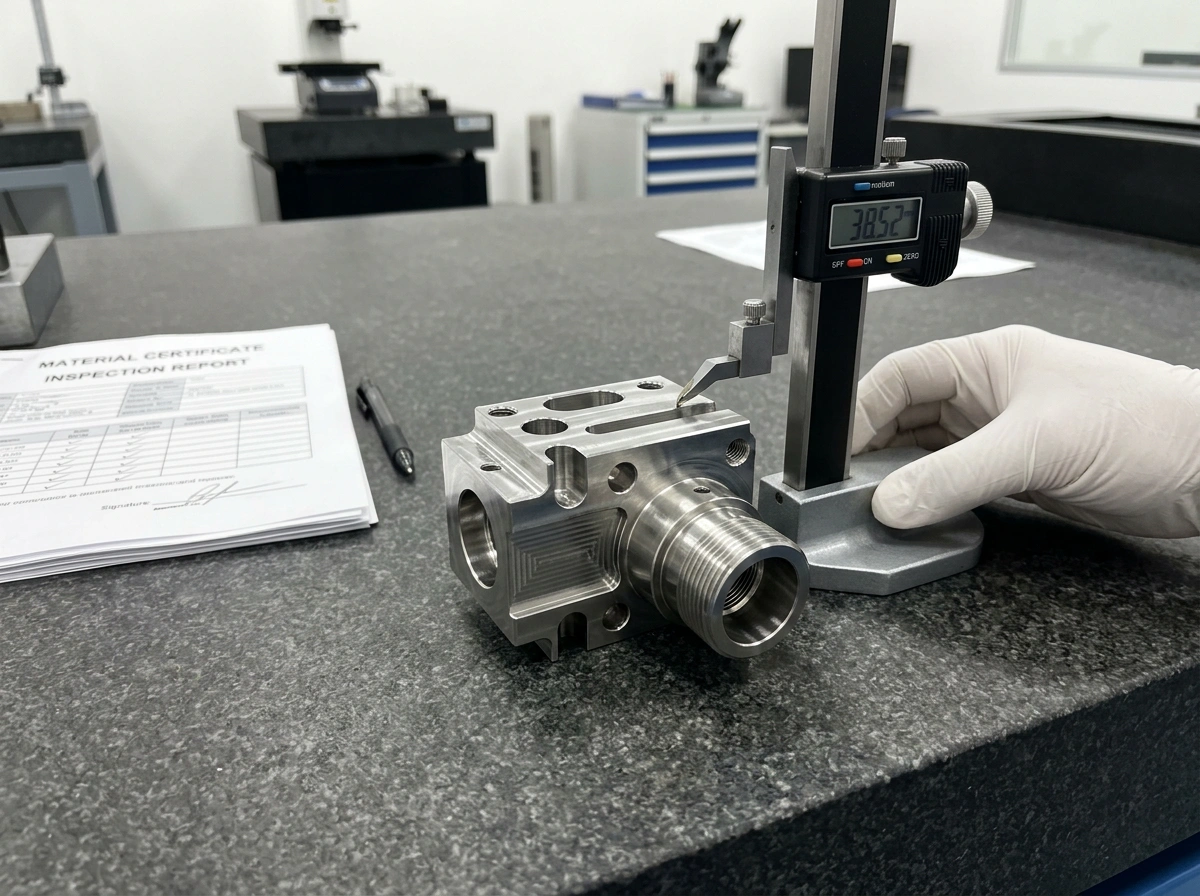
What the drawing needs to carry before a tolerance is a requirement anyone can inspect
The verification section above covers what happens after a part is cut — the records that follow it. This is what has to be on the drawing before cutting starts, so verification has something concrete to check against.
General tolerance classes such as ISO 2768 were written for metal-removal and sheet-metal parts broadly; the full class table is already published on our CNC machining hub rather than repeated here. On a medical part, the more useful question usually isn't "what's your standard tolerance" — it's which dimensions are critical to function: a mating diameter, a thread engagement length, a sealing or articulating surface. Those need an individually toleranced callout and a documented inspection method. A structural or cosmetic dimension that nothing downstream depends on tightly can sit on the general class without a special conversation.
That distinction matters because a tolerance that can't actually be measured as drawn isn't a requirement — it's a number on paper. Confirming that a specified tolerance is genuinely inspectable, and by what method, is a distinct step in reading an engineering drawing for a measurement process, not an assumption anyone should skip. Name the critical-to-function features explicitly — not just a blanket tolerance block in the title box — and the quote reflects the inspection plan those features actually need. For the broader GD&T vocabulary this section assumes, see GD&T basics for CNC machining.
Medical device categories we machine
The categories below cover the bulk of medical device work that lands here. Each one has its own regulatory weight and its own scope conversation — describe the device class and we can usually peg the right pattern from a one-paragraph brief.
Orthopedic implants
Bone plates, screws, joint components, spinal hardware. Usually Ti Grade 23 ELI or CoCrMo stock, machined to ASTM finish requirements with surface treatment and packaging scoped per the device program. The most regulated category on this list — expect a longer discovery conversation before quoting.
Surgical instruments
Scalpels, forceps, retractors, needle holders, scissors, custom procedure-specific tools. 316L for general work, 17-4 PH where the cutting edge or pivot needs hardness. Reusable instruments live thousands of autoclave cycles, so the surface finish and corrosion-resistance story matters.
Dental implants & components
Implant fixtures, abutments, healing caps, dental tooling, and prosthetic frameworks. Ti-6Al-4V dominates the implant side; CoCrMo turns up on prosthetic frameworks. Tolerance and surface treatment requirements are specific to the implant system.
Drug-delivery hardware
Syringe components, injector mechanisms, infusion-pump hardware, drug-cartridge fittings. Stainless and machinable polymers in tight-tolerance assemblies where the sealing and dispensing accuracy is the entire product story.
Diagnostic & lab instruments
Sample handlers, optical mounts, fluidics components, instrument frames, and analytical-equipment hardware. Often non-patient-contact, which simplifies the regulatory conversation considerably and broadens the alloy list.
Device housings & enclosures
Imaging-equipment chassis, monitor housings, sensor enclosures, control-panel hardware. Aluminum 6061 with a chemical conversion coat or anodize covers most non-contact device exteriors at a fraction of the cost of medical-grade alloys.
Prosthetics & orthotics
Socket fittings, joint hardware, brace components, and custom orthotic hardware. Titanium and 316L for load-bearing metal components; PEEK where a radiolucent or flex-matched polymer suits the fitting better than metal.
Rehabilitation & assistive devices
Mobility-aid hardware, exoskeleton components, and assistive-device frames and fittings. Often lower regulatory weight than an implant, with aluminum and stainless covering most structural and wear-facing parts.
Medical machining FAQs
Medical RFQ
Quote a medical device part the way an auditor expects
Send the 3D, the 2D drawing with GD&T, the ASTM material spec, the sterilization method, and the device class. The quote comes back with stock source, routing, inspection scope, and the regulatory boundaries spelled out in plain language.