
CNC Plastic Machining
Plastic is a decision before it's a cut. You pick the resin and the grade; we quote the cut against that spec, and against whichever inspection condition (dry-as-molded or conditioned) lives on your drawing. If the callout is just "engineering plastic", the quote comes back with questions, not numbers.
What we handle
- Commodity grades through high-performance thermoplastics: PEEK, Delrin, nylon, polycarbonate, PTFE, UHMW, and more — machined to the spec you release.
- Cutting strategy that respects heat buildup, moisture pickup, and stress relief on semi-crystalline stock.
- Finishing from bead blast to vapor polish, with adhesion notes for low-surface-energy plastics like HDPE and PTFE.
Why plastic needs a different conversation than metal
The part you release is not the part the tool sees. Thermal load during cutting can move a dimension before the tool ever looks wrong — softer on semi-crystalline stock, worse on fiber-filled grades. Speeds and step-down come from the resin, not a generic metal feed table; fixture support and clamp strategy likewise. Witness marks on cosmetic faces usually trace back to vacuum and soft-jaw choices that were never discussed with the print in hand.
Moisture is the other thing that bites. Nylon and other hygroscopic grades measure differently conditioned vs dry-as-molded, so we want the inspection condition stated on the drawing — not added as a surprise the week after the first lot lands at receiving.
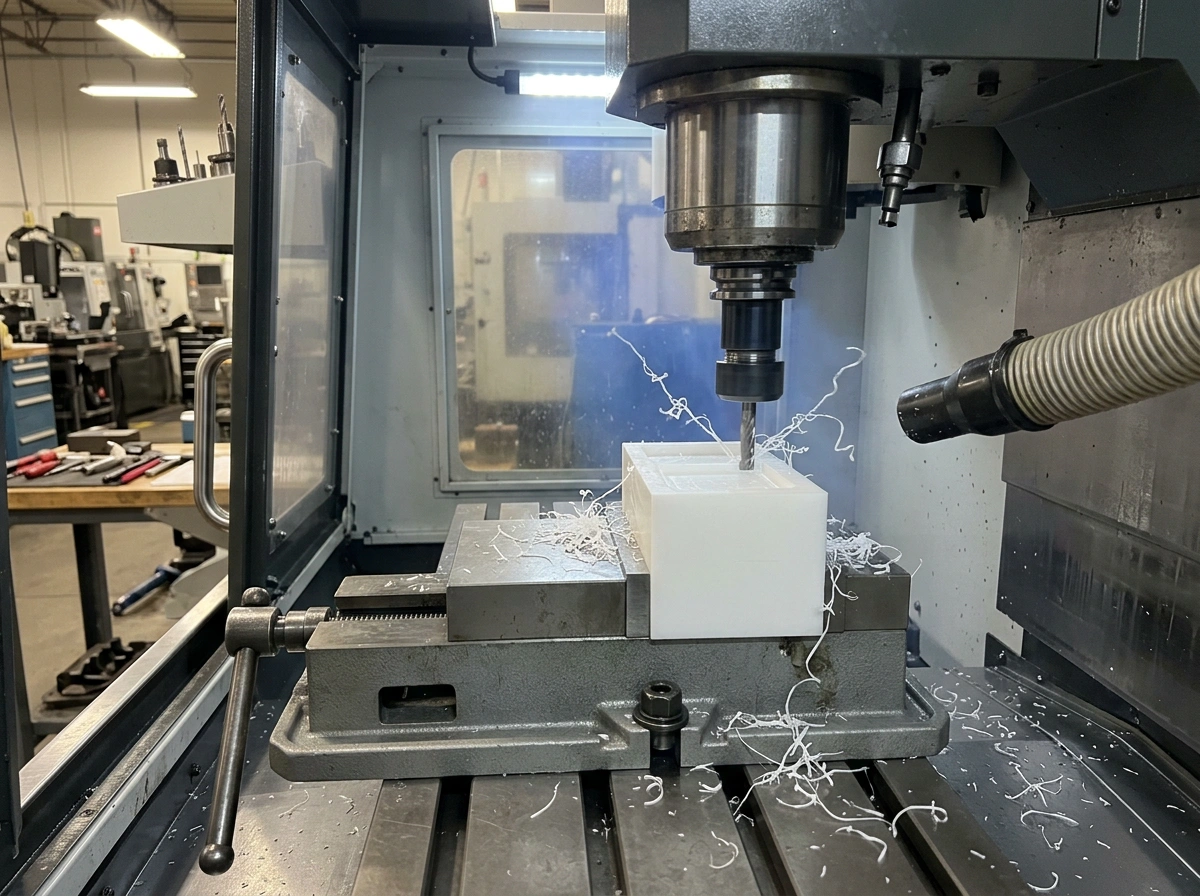
What we cover under plastic CNC
Production releases, prototype builds, quick-turn recoveries, and jobs that arrive without a drawing at all. Each lane has its own expectations about scope, review, and timeline — and the quote reflects which one you're in.
Production runs
Low- to mid-volume production off a controlled drawing. First articles land before the rest of the PO scales, so the 500th part matches the drawing intent that approved the first. Mixed routings and BOM-wide scope run under our broader CNC machining service.
Prototypes
One-off fits, functional mockups, and design iterations with short cycles and drawing-led review. Expect honest feedback when a geometry or a resin choice will cause grief during the cut. See rapid prototyping for the broader validation workflow.
Quick-turn jobs
When a failed plastic part stops an assembly line, we work the calendar backwards from the date you need the replacement in hand. Scope is confirmed up front so there are no mid-cut surprises and no finger-pointing at handoff.
Reverse engineering & drawing rebuild
No print? Send the sample. We measure, confirm the resin family where practical, and rebuild a controlled drawing before quoting the cut. Future lots then come off the drawing, not a reference part floating around the shop.
The plastic grades you'll name on a drawing
Call out the exact grade on the print. These are the families that land in most OEM RFQs; behaviour and fixture strategy change between them, and substitutions are never silent on our side.
ABS
Easy to machine, cosmetically forgiving, bonds well to paint and primer. Used for covers, housings, and fit-check prototypes. Stress cracks near fastener bosses on thin-wall parts are the usual failure mode.
Polycarbonate (PC)
Tough and transparent, but notch-sensitive and prone to stress cracking in contact with aggressive coolants. Vapor polishes to optical clarity for cover lenses and light pipes.
Acetal (Delrin / POM)
Dimensionally stable in moisture, low friction, reliable for sliding fits and small gears. Copolymer (POM-C) and homopolymer (POM-H / Delrin) have different feed windows; centerline porosity on thick homopolymer stock is worth planning for.
Nylon (PA)
Wear-resistant and quiet under load; hygroscopic. Measure conditioned or dry-as-molded, not a mix of both. Glass- and mineral-filled grades (for example PA66-GF30) shift machinability and give directional shrink that belongs on the print.
PEEK
High-temperature and chemical-resistant, costly stock, abrasive on tooling. Tight-tolerance parts often get stress relieved or annealed between roughing and finishing. Biocompatible grades exist when the spec demands them.
PTFE (Teflon)
Extremely low friction, chemically inert, very soft. Holding tight dimensions takes dedicated fixturing; painting and bonding need a surface treatment the print should call out.
PVC
Rigid, corrosion-resistant, common in fluid handling and electrical insulation. Do not overheat the cut — chlorine evolution is a real shop-floor hazard on PVC, and the routing reflects that.
UHMW-PE
Impact- and wear-pad friendly, very tough, threads poorly without inserts. Creep under clamp load is the dominant fixture risk during machining.
HDPE
Tough olefin, chemically inert, low surface energy. Painting and bonding need primers or flame treatment; if adhesion matters on your part, call the finish scope clearly on the drawing.
Acrylic (PMMA)
Amorphous and brittle, machines with clean edges, vapor polishes to glass-like clarity. Annealing before machining reduces stress cracking on tight-radius features. See acrylic machining for the grade in detail.
Polypropylene (PP)
Low density, chemical-resistant, low surface energy like other olefins. Common in lab and food-handling hardware; adhesion and thread strategy deserve early thought. See polypropylene machining for the grade in detail.
G-10 (Garolite)
Epoxy-fiberglass composite, rigid and electrically insulating. Abrasive on tools; PPE and dust control matter more than they do on thermoplastics.
Mill-heavy or turn-heavy work on these grades can also be quoted individually — see our CNC milling or CNC turning pages for process-specific detail.
Why a plastic tolerance is not an aluminium tolerance
This is the number most plastic RFQs never mention and every plastic argument eventually comes back to. Engineering plastics expand three to twelve times as much as steel for the same temperature change—so a tolerance that is routine on a metal part can be consumed by the temperature difference between our shop floor and your inspection room.
| Material | Linear thermal expansion (cm/cm/°C × 10⁻⁵) | Glass-reinforced grade | Relative to steel |
|---|---|---|---|
| Steel | 1.1 | — | 1× |
| Copper | 1.6 | — | 1.5× |
| Brass | 1.8 | — | 1.6× |
| Aluminium | 2.2 | — | 2× |
| Polycarbonate (PC) | 6.5 | 2.2 | 5.9× |
| Acrylic (PMMA) | 6.8 | — | 6.2× |
| ABS | 7.2 | 3.1 | 6.5× |
| Nylon (PA) | 8.1 | 2.3 | 7.4× |
| Acetal (POM / Delrin) | 8.5 | 4.0 | 7.7× |
| Polypropylene (PP) | 8.6 | 3.2 | 7.8× |
| Polyethylene (HDPE, UHMW-PE) | 13.0 | — | 11.8× |
Coefficient of linear thermal expansion, from Machinery's Handbook, 31st edition, Table 8. The third column is the glass-fibre-reinforced version of the same resin where the source lists one—note that reinforcement roughly halves the movement, which is often a cheaper route to a stable dimension than tightening the tolerance.
What that means on a real part. Take a 100 mm feature and a 10 °C difference between the machine and the CMM—an ordinary shop-to-inspection-room swing, not an extreme one. Steel moves about 0.011 mm. Aluminium moves about 0.022 mm. Acetal moves about 0.085 mm. HDPE moves about 0.130 mm.
Set that against a general tolerance class. ISO 2768-m for a 30–120 mm dimension allows ±0.3 mm, so on acetal that 10 °C swing has already eaten roughly 28% of the band before anyone has cut anything. Tighten to ISO 2768-f (±0.15 mm) and it is 57%. On HDPE at class f the temperature difference alone is very nearly the whole tolerance.
None of that makes a tight plastic part impossible. It makes the measurement condition part of the specification. Put the inspection temperature on the drawing, and on hygroscopic grades the moisture condition too—dry-as-moulded or conditioned. Without those two lines, a tight tolerance on a plastic drawing is not a requirement anyone can verify; it is a disagreement waiting for the first article to arrive.
What actually moves a plastic dimension
Three things move a machined plastic part after the cut: heat, moisture, and residual stress. Which of the three dominates depends on the grade—and that is what should set the tolerance conversation, not a blanket precision figure.
| Grade family | Dominant dimensional risk | What has to be on the drawing | Where the conversation usually starts |
|---|---|---|---|
| Acetal (POM / Delrin) | Thermal movement and residual stress from heavy cuts; dimensionally stable in moisture | Inspection temperature; whether an anneal sits between roughing and finishing | The tightest of the common grades—closest to a metal-style tolerance conversation |
| Nylon (PA) | Moisture absorption—all nylons are hygroscopic, and the part measures differently conditioned than dry | Measurement condition, stated explicitly: dry-as-moulded or conditioned | Realistic only once the measurement condition is fixed; unfixed, no tolerance is meaningful |
| Polycarbonate (PC) | Machining stress—PC can craze and stress-crack long after the cut | Whether an anneal is required after machining, and coolant compatibility | Good, provided the anneal is scoped rather than discovered |
| Acrylic (PMMA) | Brittleness and stress cracking at tight-radius features | Anneal before machining on stressed stock; minimum internal radii | Good on edges and flats; tight-radius internal features are the constraint |
| PEEK, PEI, PPS | Residual stress on tight-tolerance parts; abrasive on tooling | Whether stress relief between roughing and finishing is in scope | The tightest achievable of the high-performance grades, at the highest stock cost |
| PTFE | Very low stiffness—the part deflects under clamping and under the tool | Fixturing intent, and which surfaces may carry clamp witness | The loosest realistic band of the grades on this page; dedicated fixturing changes it |
| PP, HDPE, UHMW-PE | Highest thermal expansion here, plus creep under clamp load | Inspection temperature, clamp strategy, and whether creep is expected in service | Generous general tolerances; tighten individual features only where function needs it |
| PVC | Heat sensitivity—the cut must not overheat | Nothing unusual dimensionally; the constraint is on feeds, not the print | Comparable to ABS, with a routing constrained by heat |
| G-10 / epoxy-glass | Tool wear and edge quality rather than movement—the laminate is dimensionally stable | Edge-quality expectation and whether delamination at edges is acceptable | Stable; the cost driver is tooling and dust extraction, not tolerance |
The practical advice is the same on every one of them: start from a general tolerance class, tighten only the features that carry function, and state the measurement condition. The alternative—an unqualified “high precision” note on a plastic drawing—produces a quote full of assumptions and a first article nobody can agree about.
Plastic is machined against the same drawing discipline as everything else here; the general tolerance classes are set out on our CNC machining page, and grade-specific process detail on CNC milling and CNC turning.
Annealing and stress relief: when it is required, and what it costs you in schedule
Plastics may need annealing before machining to avoid warpage, and stress relief after heavy cuts to stop a part moving in service. Some bar and rod stock arrives already annealed; some does not. Either way it is a routing step with a real duration, and it belongs in the quote rather than in an apology.
| Grade | Method | Temperature | Time | Why |
|---|---|---|---|---|
| Acetal (Delrin / POM) | Air-circulating oven | 160 ± 2 °C | 30 min to reach temperature, then 5 min per mm of wall thickness | Relieves machined-in stress, especially after heavy cuts; normally done before final light finishing passes |
| Acetal (Delrin / POM) | Oil bath | 160 ± 2 °C | 5 min per mm of wall thickness once the part reaches bath temperature (15–20 min) | Faster heat transfer than air—30 min in oil is equivalent to 1 hour in air |
| Nylon (PA) | Immersion in boiling water | 100 °C | 15 min per 3 mm of cross-section | Acceptable stress relief where service temperature stays at or below 70 °C; also partially moisture-conditions the part, which matters on a hygroscopic grade |
| Polycarbonate (PC) | Supported in an oven | 127–132 °C (260–270 °F) | 30 min per 5 mm (0.2 in) of part thickness | Relieves machining stresses that otherwise cause stress cracking and crazing long after the cut |
| Acrylic (PMMA) | Forced-air oven | About 10 °C below the temperature that would distort the part | Section-dependent; thin sections typically around 2 hours | Standard practice before solvent cementing, to minimise the internal stresses that cause crazing |
| PEEK, PEI, PPS | Stress relief between roughing and finishing | Per the stock supplier's schedule for the grade and section | Standard practice on tight-tolerance parts; confirm the schedule with the supplier for the specific grade rather than assuming a generic cycle | |
Sources: DuPont General Design Principles for Engineering Polymers for acetal and nylon, Bayer Part and Mold Design for polycarbonate, MIL-HDBK-691B for acrylic, and Machinery's Handbook 31st edition for the general rule that plastics may require annealing before machining to avoid warpage.
If a tolerance on your drawing is tight enough to need one of these steps, say so in the RFQ—or ask, and we will tell you. An anneal added after the fact is a second heat cycle on parts that have already been finished, which is the expensive way to find out.
Why a steel feed table fails on plastic
Plastic moduli are a small fraction—roughly two to ten per cent—of those of metals. That single fact drives everything else: the work deflects under the tool, so it has to be held and supported firmly, and sharp tools are essential to keep cutting forces and heat down.
Tool geometry
A positive rake of about 0–5° suits most engineering plastics; polycarbonate takes considerably more, into the 5–25° range. Front and side clearance angles of 10–15° keep the tool heel off the part. Sharp edges are not a preference here—a dull tool rubs, and rubbing on a plastic is heat.
Heat has nowhere to go
The low thermal conductivity of plastics means much of the cutting heat is absorbed by the tool rather than carried away in the chip. Compressed air is a common and acceptable coolant; misted or flooded coolants can be used, but metal cutting fluids and oils may degrade or attack some plastics outright.
Turning
A fine-grained C2 carbide cutter with a small cutting radius and a broad-nosed finishing edge avoids material build-up. Cut depth of at least 0.004 in is recommended, with higher cutting speeds where feasible. On small-diameter or flexible work a live centre or steady stabilises the part and improves both tolerance and finish.
Drilling
Drills want large helix angles, narrow lands, and highly polished or chromium-plated flutes to expel swarf fast and minimise frictional heating. Deep holes take aqueous solutions rather than oils. The work must be held firmly—the tool will otherwise grab and spin it.
Elastic recovery
Plastics recover elastically during and after machining. Drilled and tapped holes often finish tapered, or smaller than the tool that made them; turned diameters can end up larger or smaller than they measured immediately after the finishing cut. This is normal behaviour, not a process fault—and it is why measurement timing gets discussed.
Filled and reinforced grades
Glass and mineral fill change everything twice over: reinforced grades are abrasive on tooling and may need carbide, and their thermal expansion is roughly half that of the unfilled resin. Reinforcement is often the cheapest route to a stable dimension—but it belongs on the drawing, because it changes the part.
Starting cut parameters by grade
Published starting points for peripheral end milling, from Machinery's Handbook: a 2-fluted 1 in end mill, 0.250 in roughing depth of cut and 0.050 in finishing depth of cut. Real programmes deviate from these—they are a reference point, and a useful sanity check on a quote.
| Grade | Roughing speed (ft/min) | Roughing feed (in/rev) | Finishing speed (ft/min) | Finishing feed (in/rev) |
|---|---|---|---|---|
| ABS | 600 | 0.018 | 480 | 0.008 |
| Acetal (POM) | 600 | 0.012 | 480 | 0.005 |
| Acrylic (PMMA) | 450 | 0.012 | 360 | 0.005 |
| Nylon (PA6 / PA66) | 800 | 0.012 | 480 | 0.005 |
| Polycarbonate (PC) | 500 | 0.012 | 450 | 0.005 |
| PEEK | 450 | 0.010 | 360 | 0.004 |
| Polyethylene (HDPE, UHMW-PE) | 800 | 0.018 | 620 | 0.008 |
| Polypropylene (PP) | 800 | 0.018 | 620 | 0.008 |
| PTFE | 600 | 0.012 | 480 | 0.005 |
| PVC | 600 | 0.010 | 480 | 0.004 |
| PPS | 450 | 0.015 | 360 | 0.006 |
| PEI (Ultem) | 450 | 0.012 | 360 | 0.005 |
G-10 and other epoxy-glass laminates are not in that table and should not be inferred from it—they are thermosets, they are abrasive, and tool life rather than speed governs the programme.
Working backwards: from requirement to grade
Most RFQs that arrive without a grade arrive with a requirement instead—“it has to survive this chemical”, “it runs dry against steel”, “it sits at 150 °C”. That is a better starting point than a guess at a resin. Here is the shortlist each requirement usually produces.
| What the part has to do | Grades worth shortlisting | What still has to be stated on the drawing |
|---|---|---|
| Run as a dry bearing or wear surface | Nylon for general-purpose bearings and wear surfaces; PTFE for sliding or low-speed dry bearings; acetal where the service is humid or submerged; filled fluoropolymers for heavier loads and creep resistance | Load, speed, mating surface, and whether lubrication is present |
| Resist aggressive chemicals | PTFE and other fluoropolymers first; PVC, polypropylene, and HDPE for many acids and bases; PPS where chemical resistance and temperature both matter | The specific chemical, concentration, and temperature—“chemical resistant” is not a specification |
| Hold up at continuous high temperature | PEEK, PEI, PPS, and fluoropolymers | Continuous service temperature and whether the part is loaded while hot |
| Stay dimensionally stable in humidity | Acetal and polycarbonate, both noted for low moisture absorption; avoid unfilled nylon unless the measurement condition is controlled | The measurement condition, and the humidity the part actually lives in |
| Insulate electrically | G-10 / epoxy-glass laminate for rigid structural insulation; PTFE and PVC for wire and fluid-adjacent work | Voltage, dielectric requirement, and any flammability rating your assembly must meet |
| Be transparent | Polycarbonate where impact matters; acrylic where optical clarity and edge quality matter more than toughness | Whether vapour polishing is in scope, and the optical requirement in real terms |
| Survive impact | Polycarbonate for intermittent very high impact; UHMW-PE where abrasion and impact combine | Whether the loading is repeated and cyclical—that changes the answer, and polycarbonate is not the grade for it |
| Be a cheap fit-check prototype | ABS, then acrylic where you need to see through it | Whether the prototype needs to behave like the production resin or merely fit like it |
Shortlists drawn from published material-selection guidance in MIL-HDBK-700A. They are a starting point for a conversation, not a substitute for your own qualification—which is exactly why the third column exists.
Two grades on this page have their own detail pages: acrylic machining and polypropylene machining. For metal alternatives to any of the above, see metal machining; for reinforced composites, carbon fibre machining.
Call the grade by name, not by color
"Black plastic" is not a spec. PEEK, Delrin / acetal, nylon, UHMW-PE, and G-10 each machine differently and behave differently under heat, load, moisture, and chemistry — and each has a default color that is easy to mistake for another grade across a stock room. A nylon bushing and a Delrin bushing look interchangeable on a bin shelf; in a sliding fit with moisture in the environment, they are not.
Each resin family has its own failure mode. ABS stress-cracks near fastener bosses on thin walls. Polycarbonate is notch-sensitive and reacts to the wrong coolant. Nylon is hygroscopic, so measurements on a conditioned part do not match measurements on a dry-as-molded part. PEEK is abrasive on tooling and usually stress-relieved between roughing and finishing on tight-tolerance parts. PVC releases chlorine if the cut overheats — a real shop-floor hazard that constrains feeds and speeds. PTFE holds poor dimensions without dedicated fixturing. Every one of those points starts from the resin name on the drawing; none of them survive a generic "plastic" callout.
Put the resin name, the stock form, and any fill or reinforcement — glass-filled PA66-GF30, MoS₂-filled nylon, implant-grade PEEK — on the drawing. Add the measurement condition on hygroscopic grades and the adhesion requirement on low-surface-energy olefins like HDPE and polypropylene. Those lines keep the RFQ honest, the first article on target, and substitutions out of the conversation. We do not swap grades silently; the drawing is the instruction, and the quote is the answer to it.
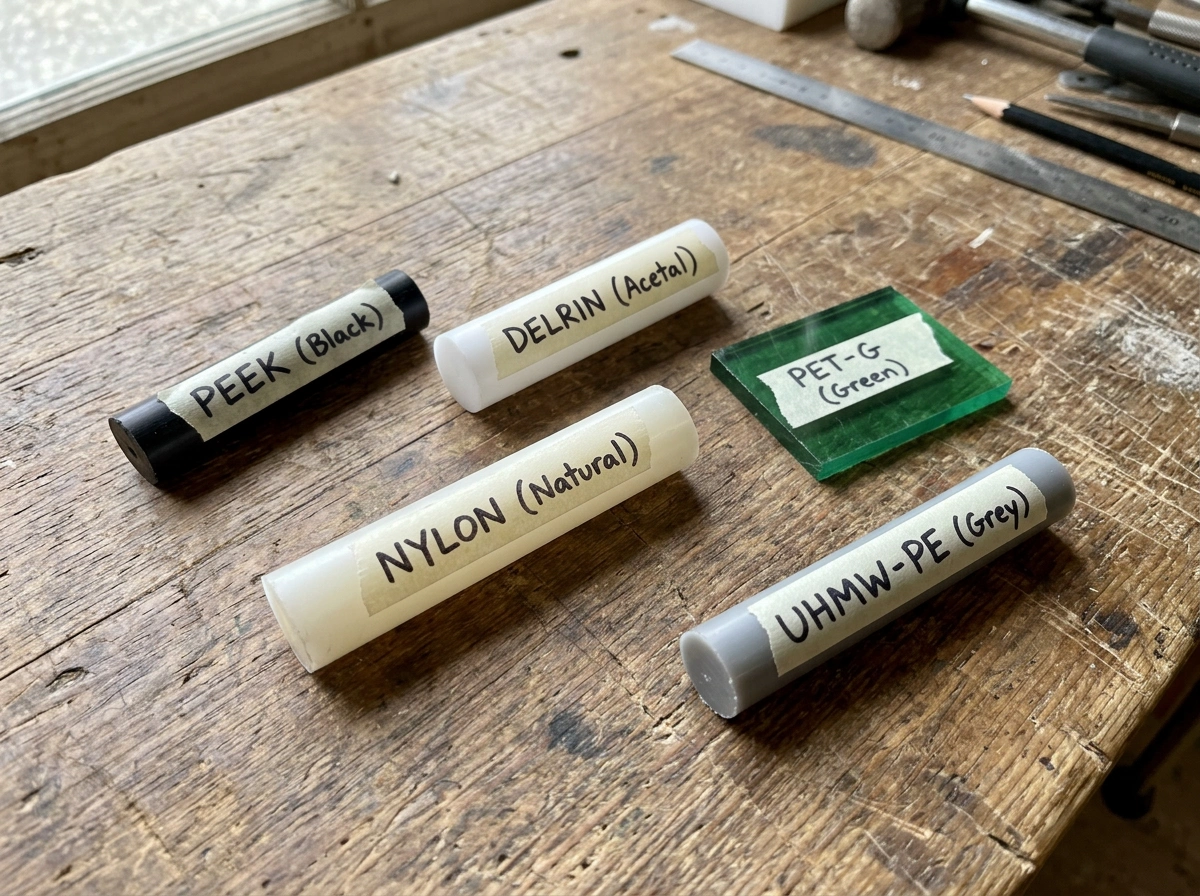
Finishing plastic parts: what works, what fights back
Finishing on plastic is more about chemistry and surface energy than it is on metal. Below is the short version of what works with what — longer conversations happen on the drawing review.
| Method | How it works | Best for | Watch-out |
|---|---|---|---|
| Bead blasting | Abrasive particles strike the surface at low pressure, leaving a uniform matte finish. | ABS, nylon, PC, and HDPE housings that need tool marks hidden. | Soft resins like UHMW and PTFE can absorb media; call it out before scope. |
| Tumbling | Small parts ride in abrasive media for deburring and edge-rounding. | Gears, fittings, and mid-volume deburr on Delrin, HDPE, and nylon. | Not a cosmetic finish; witness patterns vary with run time and media. |
| Powder coat | Electrostatic powder, then heat cure; durable, abrasion- and chemical-resistant. | ABS, nylon, and reinforced grades with decent surface energy. | Low-surface-energy plastics (HDPE, PTFE, PP) need primer or flame treatment — often not worth it. |
| Vapor polish | Solvent vapor melts the surface skin back to optical clarity. | Polycarbonate and acrylic cover lenses, light pipes, and see-through housings. | Aggressive on filled grades; never run on a material the safety data sheet hasn't cleared. |
| Custom (case-by-case) | Biocompatible coatings, anti-static treatments, conductive fills, custom tints. | Medical, robotics, instrumentation, and regulated-industry work. | Scope is confirmed in writing per line before material is released. |
Finishing coordinates through surface finishing when your print calls for combined operations on the same part.
Plastic machining FAQs
Plastic RFQ
Ready for a plastic CNC quote?
Upload the 3D, the 2D print, and the resin callout. We come back with a fixture plan and finishing scope, plus the inspection intent you need on the drawing, before material is cut.