
CNC Metal Machining
Most OEM jobs arrive in metal for a reason: stiffness, wear, thread strength, thermal path, conductivity — those are the properties a purchase order is usually trying to preserve, and they are the reason a stamped or molded alternative didn't make the cut.
A useful quote tells you that "aluminum" isn't specific enough on a drawing. AL6061-T6 behaves very differently from 7075; SS303 machines noticeably faster than 316. The grade, not just the family name, drives routing, tooling, and inspection.
What we handle
- Aluminum, stainless, carbon and alloy steels, copper alloys, titanium, brass, and magnesium, with the grade and temper driven by your drawing.
- Routing mixes 3-, 4-, and 5-axis milling, lathe work, mill-turn centers, and (where geometry calls for it) wire or sinker EDM and surface grinding.
- Finish stack confirmed before the cut: anodize, plating, passivation, blast, paint, or none at all.
Specify the grade, not just the metal
The shortest path to a useful metal quote is naming the alloy on your drawing the same way the mill names it on the certificate. "Aluminum" leaves the shop guessing between roughly twenty commercial options. "AL6061-T6" tells us the alloy, the temper, and most of the routing decisions in five characters.
What follows on this page is the short list of alloy families we machine, what each one is actually used for, where they sit on the cost ladder, and which process route a given feature usually wants. Use it as a planning sheet during early design — the eventual quote always comes back to the drawing.
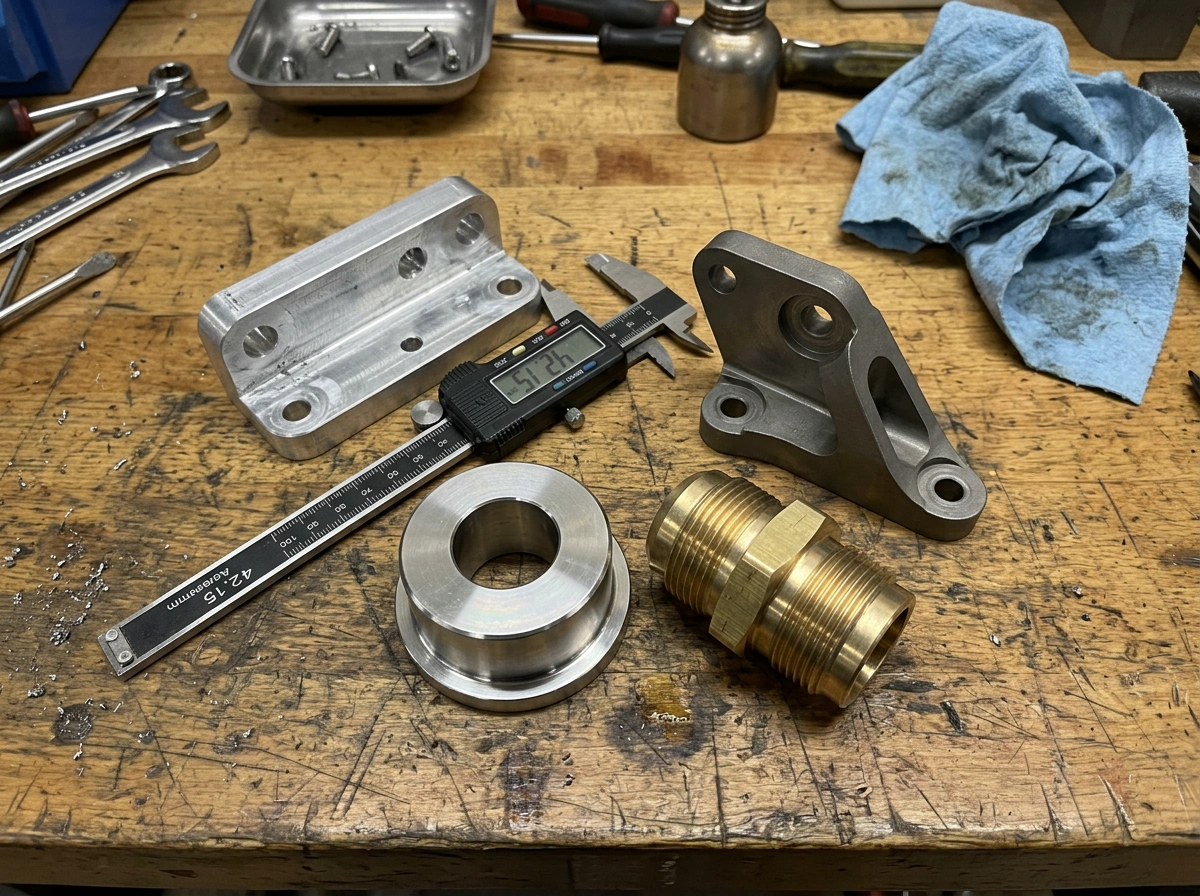
Alloy families we machine
Six broad families cover the majority of OEM machined parts. Name the exact grade on your drawing — "aluminum" narrows the shortlist to about twenty commercial options, and the one you actually want usually matters.
Aluminum — 6061-T6, 7075-T6, 6082
The cost-conscious metal on most OEM BOMs. 6061-T6 is the default for housings and brackets: good machinability and weatherproof corrosion resistance, weldable when you need to join sections. 7075-T6 trades some weldability for about a third more strength; 6082 is the European-flavored 6061 with slightly higher yield. Specify the temper — we don't swap T6 for T4 silently.
Stainless — 303, 304, 316
Corrosion resistance drives the choice; machinability comes second. 303 (DIN 1.4305) has sulfur added for free-machining and is the default for fasteners and gears. 304 (DIN 1.4301) is the general-purpose austenitic. 316 (DIN 1.4401) adds molybdenum for pitting resistance and is the medical and marine default. Work-hardening in the cut is planned into every one.
Carbon & alloy steels — 1018, 1045, 4140
Strength and heat-treatability. 1018 (DIN 1.0401 / C15) cold-rolled is the default for shafts and brackets that don't need hardening. 1045 (DIN 1.0503 / C45) takes an induction-hardened surface well. 4140 (DIN 1.7225 / 42CrMo4) is the pre-hardened Cr-Mo alloy used for stressed parts, fasteners, and gears. Tell us whether heat treat happens before, after, or both; the order changes routing.
Copper & brass — C110, C360, H59
Conductivity and low-friction work. C110 is ETP copper for electrical lugs, buses, and thermal contacts. C360 (DIN 2.0401 / CuZn39Pb3) free-machining brass is the easiest metal in the shop; H59 is the common Asian equivalent for fittings and hardware. Burr strategy and tarnish control dominate quoting conversations on both.
Titanium — Grade 2, Grade 5 (Ti-6Al-4V)
Strength-to-weight at a real cost premium. Commercially-pure Grade 2 (DIN 3.7035) is used for corrosion resistance; Grade 5 (Ti-6Al-4V, DIN 3.7165) is the aerospace and medical workhorse. Tool wear is significant and stock cost is high, so first-article strategy on titanium looks very different from first articles on aluminum.
Magnesium — AZ31, AZ91
The lightest common structural metal. Used for cases, housings, and portable hardware. Excellent machinability on paper, but chip control and fire prevention are real shop considerations rather than rhetorical warnings. Routing and coolant choices reflect that.
Relative cost by metal family
Indicative ranking, not a quote. Real price depends on geometry, lot size, tolerance, finish scope, and inspection — use the column to rule grades in or out during early design, not to negotiate.
| Metal family | Relative machined cost | Main cost driver |
|---|---|---|
| Aluminum (6061, 7075) | $ | Fast feeds, low-cost stock, long tool life |
| Brass (C360, H59) | $ | Free-machining; stock price tracks copper |
| Carbon & alloy steel (1018, 4140) | $$ | Cheap stock, moderate tool time, heat-treat routing |
| Copper (C110) | $$ | Stock cost dominates the quote |
| Magnesium (AZ31) | $$ | Chip control and fire precautions add overhead |
| Stainless (303, 304, 316) | $$$ | Work-hardening slows the cut |
| Titanium (Grade 2, Grade 5) | $$$$ | Expensive stock, short tool life |
Process routes for metal parts
Most metal parts touch more than one machine. Below is the short list; the quote calls out which features go through which process so you can see the cost driver per line.
3- and 4-axis milling
Prismatic work: pockets, walls, patterns, fastener bosses. Best when the geometry is accessible from two or three faces without complicated re-clocking.
5-axis milling
When a part has multiple non-orthogonal faces that need to hit in a single setup, reducing re-fixturing error on datum-rich parts. See our CNC milling page for detail on fixturing and approach.
CNC turning (lathe)
Shafts, sleeves, fittings, bores, threads, concentric features. Stock goes in round or hex; rotational symmetry does the heavy lifting, live tooling handles anything off-axis.
Mill-turn centers
A turning spindle paired with live milling tooling. Saves a fixture pass on mid-complexity parts that would otherwise need both a lathe and a mill; cross holes and flats happen in the same clamp as the turning work.
Wire and sinker EDM
Hardened steel features and small-radius profiles that endmills cannot reach. Slower per cubic millimetre but unmatched for geometry a rotating cutter simply cannot see.
Surface grinding
Flatness and parallelism to tolerances milling won't hold on its own. Usually the finishing operation after a heat-treat step on hardened parts.
Mixed routings and full-BOM scope sit under our broader CNC machining service when you want a single release story. Turning-specific detail lives on the CNC turning page.
Heat treat, plating, and the finish stack
The machining step is rarely the whole cost story on a metal part. A 4140 shaft may need rough cut, normalize, finish cut, nitride, and grind — five routed operations before it ships. An anodized 6061 housing has to hit dimension after the coating thickens it a predictable amount. Passivating a 316 bracket strips a few microns and can shift inspection against the class-of-fit gauge.
We quote the sequence, not just the cut. If the print calls for "plated per ASTM B633", we factor coating thickness into pre-plate dimensions. If heat treat distorts a shaft, we build straightening into the router before the grind. Chasing a decimal mid-run because nobody planned the post-op stack is how good schedules go sideways — coatings coordinate through surface finishing when a print combines anodize, plating, or passivation scope.
Metal machining FAQs
Metal RFQ
Price and route your metal part
A metal quote that gives you one machining number is hiding work. Send CAD, the 2D drawing, alloy, temper, and finish notes — we break routing, tool time, fixture, and inspection into lines you can read.