
CNC Polypropylene Machining
Polypropylene is the cheapest engineering thermoplastic that survives an industrial wash-down. That single fact is why it ends up everywhere food, lab, and chemical equipment touches the part — guide rails, mixer components, chemical-handling fixtures, lab consumables. None of those applications care about the strongest plastic on the shelf; they care about the one that doesn't degrade under the daily clean cycle.
For food-contact use specifically, PP grades that meet FDA 21 CFR 177.1520 are widely available from material suppliers. Name the regulation on your drawing, send the spec, and we will source against it before the cut.
What we handle
- Standard, copolymer, and reinforced PP grades — including the food-contact-compliant white PP that turns up in most sanitary equipment.
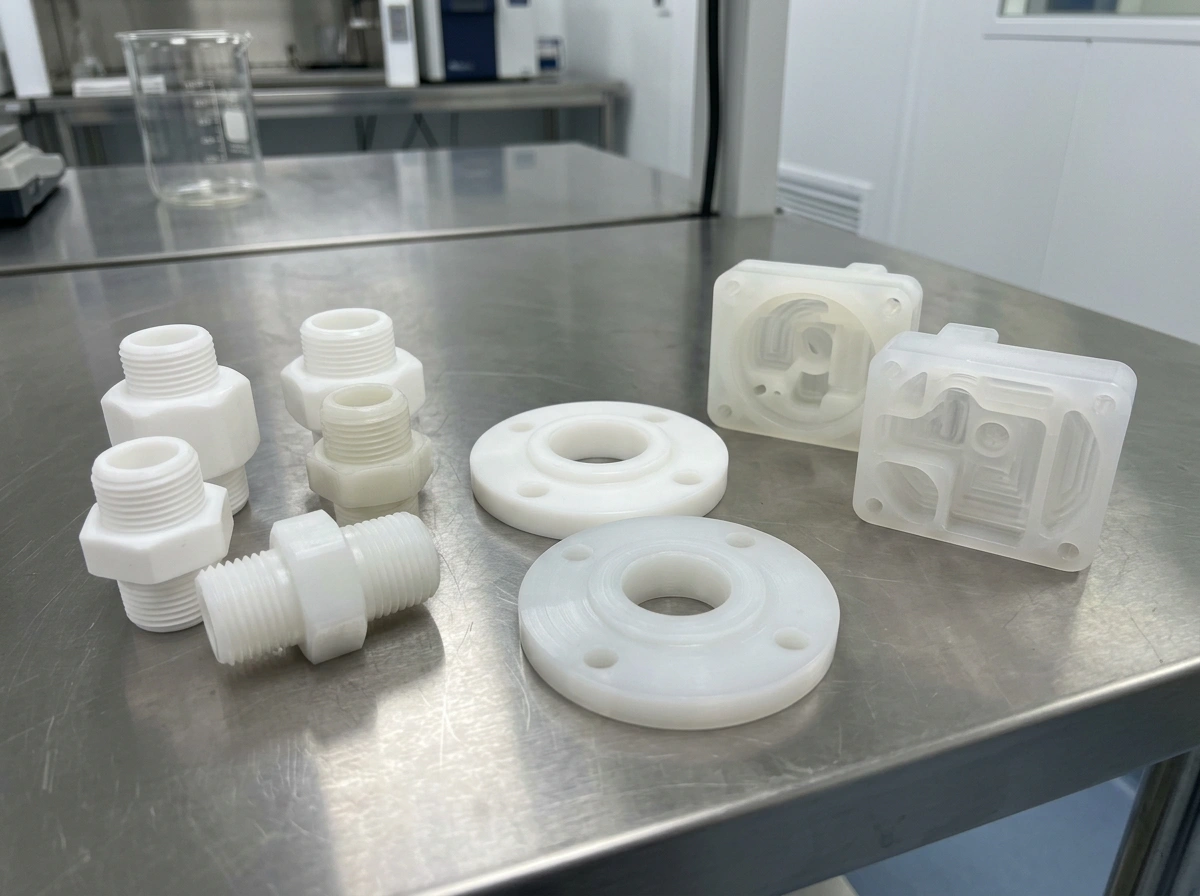
- Wear strips, guide rails, mixer paddles, valve bodies, trays, fixtures, and lab consumables — milled, drilled, and tapped from sheet, plate, or rod.
- Honest fixture and feed strategy for a soft, low-friction polymer that punishes lazy clamping.
Why polypropylene shows up wherever something gets washed
Sanitary equipment lives a hard life. Hot water, caustic detergents, acid descalers, and pressure-washer rinses run across the same surfaces every shift, year after year. Stainless steel handles it but costs real money. Many engineering plastics pit, swell, or stress-crack within a few cleaning cycles. PP sits in the narrow window where the chemistry holds up and the cost stays sane — which is why an FDA-compliant white PP wear strip is a buy-it-by-the-pallet item in the food industry, not a specialty order.
From a machining standpoint, PP is forgiving on the spindle and unforgiving on the fixture. It cuts easily but moves under clamp pressure, and a thread tapped straight into untreated PP without backing creep into the wall is asking for trouble. The rest of this page covers the real properties, how PP compares to the alternatives a buyer might consider, the parts it actually shows up on, and the questions that need an answer before we quote.
Polypropylene at a glance
Public datasheet values for unfilled, food-contact-grade homopolymer PP. Specific numbers shift with the grade, the supplier, and any reinforcement — confirm against the actual mill cert before locking a tight tolerance against any of these.
| Property | Typical value | Why it matters |
|---|---|---|
| Density | ~0.91 g/cm³ | Lightest of the commodity thermoplastics — floats in water, easy to handle in long lengths |
| Tensile strength | ~33–36 MPa | Modest by metal standards; adequate for most non-load-bearing food and lab hardware |
| Water absorption | < 0.01% (24 h) | Effectively zero — dimensions don't drift with humidity, no bacterial moisture trap |
| Melting point | ~165 °C | Survives steam cleaning and most sanitization chemistry; not a high-temperature engineering plastic |
| Continuous service temperature | −20 °C to ~90 °C | Safe across cold-storage, ambient, and standard wash-down environments; pick PEEK or steel above this range |
| Chemical resistance | Excellent against acids, bases, alcohols, and most cleaning chemistry | The reason PP exists in food and chemical equipment in the first place |
PP versus the obvious alternatives
Most polypropylene RFQs land on our desk because the buyer is choosing between PP, HDPE, PEEK, and stainless steel. Here is the short answer to "why not the other one".
| Property | Polypropylene | HDPE | PEEK | Stainless steel |
|---|---|---|---|---|
| Relative cost | $ | $ | $$$$ | $$$ |
| Max continuous temperature | ~90 °C | ~80 °C | ~250 °C | ~550 °C+ |
| Chemical resistance | Excellent | Good | Excellent | Good (poor against chlorides) |
| Impact resistance | Good | Excellent | Good | Excellent |
| Weight for the same part | Very light | Very light | Light | Heavy |
Quick reading of the table: HDPE beats PP on impact and matches on cost, so reach for it on cutting boards and high-impact bumpers; PP wins on slightly higher temperature and chemical resistance for wash-down hardware. PEEK is the answer when temperature exceeds 100 °C or the chemistry is genuinely aggressive — but at four to five times the stock cost, you only pay for it when you have to. Stainless steel wins on temperature, durability, and load capacity, and costs accordingly; it's the right answer when the part must outlast every other component on the line. The broader plastic machining page covers other engineering thermoplastics that compete in the same RFQ window, and metal machining covers the steel and aluminum side.
Where PP actually earns its spot on the BOM
Polypropylene wins in the narrow window where wash-down, chemistry, and cost all matter at once. Sanitary equipment lives a hard life — hot water, caustic detergents, acid descalers, and pressure-washer rinses run across the same surfaces every shift. Stainless steel handles that punishment but costs real money. Most other engineering plastics pit, swell, or stress-crack within a handful of cleaning cycles. PP sits between them, and an FDA-compliant white PP wear strip is a buy-it-by-the-pallet item in the food industry, not a specialty order. For food-contact use, PP grades that meet FDA 21 CFR 177.1520 are widely available; name the regulation on the drawing and we source against it.
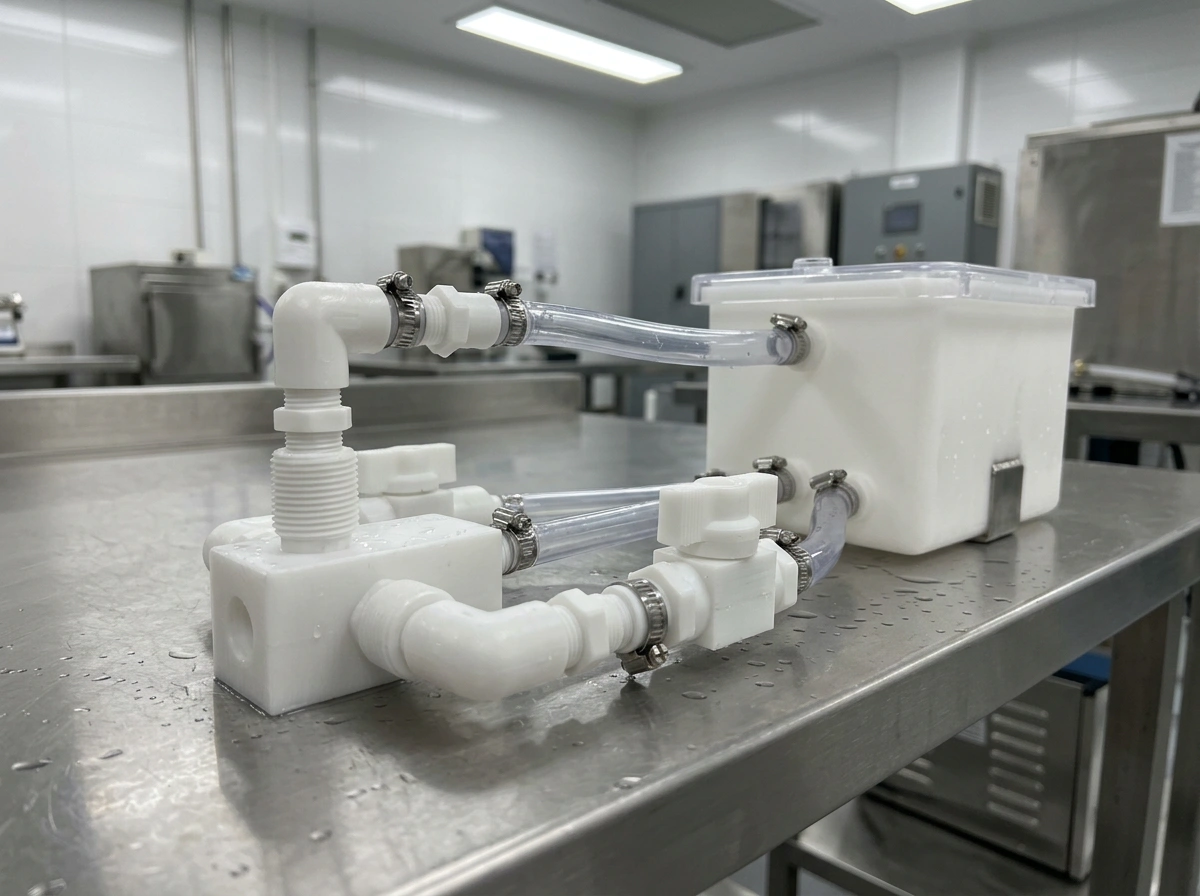
The parts PP actually earns a spot on are the predictable ones: guide rails, wear strips, mixer paddles, valve bodies, tank fittings, pipe flanges, lab housings, trays, splash-zone covers, and fixtures for lines that get sprayed down at shift change. Most of these are non-load-bearing at ambient to moderate temperature — which matches PP's ~33–36 MPa tensile strength and its roughly −20 °C to 90 °C continuous-service window. Above 100 °C or under aggressive load, PEEK or stainless starts looking more honest than PP stretched past its range.
Where PP trips up is the fastener strategy and clamp plan. The material cuts easily but moves under clamp pressure, and a thread tapped straight into untreated PP without backing creeps into the wall and loosens. Specify a metal insert, a through-bolt with backing plate, or a bonded hardware approach where the drawing needs a reliable fastener. Bring the chemistry the part sees, the service temperature, and the fastening method to the RFQ, and the quote comes back with a routing that matches how the part actually lives.
Where polypropylene parts actually end up
Six categories cover the bulk of PP machining work that lands here. Yours will look like one of these or a hybrid — describe the function and we can usually identify the closest pattern from a one-paragraph brief.
Conveyor & guide hardware
Wear strips, guide rails, chain guides, transfer plates, and brackets that ride alongside food and bottle lines. The job is low friction against moving product and tolerance for cleaning chemistry — not maximum strength.
Containers & trays
Portion trays, sterilization trays, ingredient holders, and custom storage containers. Often machined from sheet stock rather than molded for short-run, oddly-sized, or fixture-specific work.
Mixer & valve components
Mixer paddles, valve bodies, valve seats, and dispensing fixtures where chemical compatibility with the product matters more than rigidity. Threads usually live in metal inserts, not the PP itself.
Cutting boards & food-prep surfaces
Cutting boards, prep boards, and contact surfaces where impact resistance matters as much as chemistry. Some of this work goes to HDPE instead — the comparison table above explains when each one wins.
Lab & life-science consumables
Carriers, racks, fixtures, fume-hood hardware, and one-off lab consumables. Chemical resistance and the ability to autoclave certain PP grades are the reasons it sits on so many lab benches.
Wash-down enclosures & fixtures
Machine guards, splash shields, sensor housings, and fixtures that live in pressure-washer environments. The combination of weight (PP is half the density of aluminum) and corrosion immunity is the win here.
Mixed-material assemblies that pair PP parts with metal frames or hardware route through our broader CNC machining service; the specific milling and turning detail lives on the CNC milling and CNC turning pages.
Polypropylene machining FAQs
Polypropylene RFQ
Quote a PP part the right way
Send the 3D, the 2D drawing, the grade or the food-contact regulation it has to meet, and the cleaning chemistry the finished part will live with. The quote comes back with stock, fixture, insert, and finishing scope on separate lines.