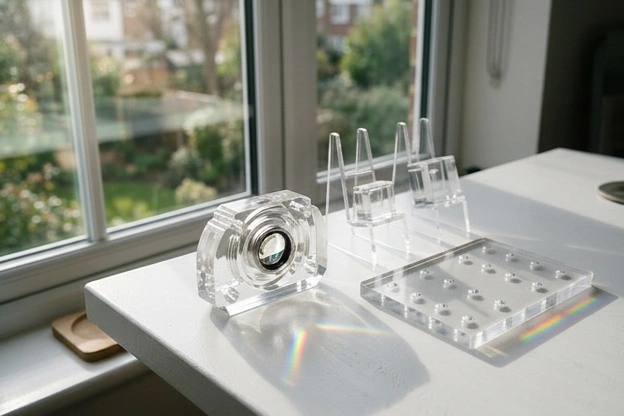
Clear plastic parts get specified for optical clarity first, then everything else — impact resistance, chemical resistance, machinability, cost — gets sorted out afterward. Acrylic (PMMA) and polycarbonate (PC) both machine into cover lenses, light pipes, sight glasses, and enclosure windows, but they behave differently enough on the machine and in the field that picking the wrong one shows up later as cracked parts, hazy edges, or a cost overrun that didn't need to happen.
Optical Clarity: Both Are Clear, Neither Is Identical
Acrylic has slightly higher light transmission (typically ~92%) than polycarbonate (~88-90%) and a lower tendency to yellow under long-term UV exposure without a coating. Polycarbonate's optical clarity is still excellent for most applications, but if a part is judged side-by-side against a reference sample under bright light — a common gate on cosmetic optical parts — acrylic's edge in clarity and lower haze is often the deciding factor.
Impact Resistance: Where Polycarbonate Wins Decisively
This is the biggest practical difference between the two materials. Polycarbonate is roughly 250 times more impact-resistant than acrylic and is the material behind bullet-resistant glazing and machine guarding windows. Acrylic is comparatively brittle — it will crack or shatter under an impact load that polycarbonate simply flexes through.
If the part is a light pipe or a cosmetic lens in a low-stress location, acrylic's impact resistance is more than sufficient. If the part is an enclosure window, a machine guard, or anything in a location where it could get dropped, struck, or impacted during handling or service, polycarbonate is the safer default.
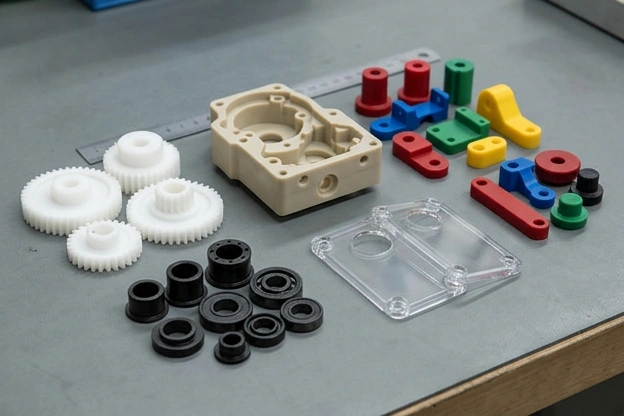
Machinability: Acrylic Cuts Cleaner, Polycarbonate Machines Tougher
Acrylic machines to a cleaner edge and takes a higher-quality as-machined finish, but it's also more prone to cracking or crazing under machining stress — particularly around drilled holes, thin walls, and sharp internal corners, where stress concentrates. Sharp tooling, appropriate feeds and speeds, and generous internal radii all reduce this risk, but acrylic's brittleness sets a lower ceiling on how aggressive a machining plan can be.
Polycarbonate is tougher and more forgiving under the tool — less prone to chipping or cracking — but it's also more prone to melting or gumming at the cutting edge if heat isn't managed. Both materials benefit from sharp, polished tooling and coolant or air-blast heat management; the failure modes are just different.
Cast vs Extruded Acrylic: A Choice Inside a Choice
Acrylic sheet comes in two forms that matter for machined parts.
Cast acrylic
Poured and cured in sheet form, giving more consistent optical quality, better chemical resistance, and — critically for machined parts — more forgiving machining behavior because internal stresses are lower and more evenly distributed. Cast acrylic is the default choice for parts with tight tolerances, polished edges, or engraved/etched detail.
Extruded acrylic
Manufactured by continuous extrusion — faster and cheaper, but with more internal stress in the sheet. That stress makes extruded acrylic more prone to cracking during machining, especially around drilled or tapped holes, and it doesn't vapor-polish or laser-engrave as cleanly. Extruded acrylic suits large flat panels with simple geometry and no tight optical requirement; for anything with drilled features, sharp corners, or a polish spec, cast is worth the added material cost.
Vapor Polishing: An Acrylic-Specific Finishing Option
Machined acrylic edges come off the tool with visible witness marks. Vapor polishing — exposing the edge to a solvent vapor that briefly melts and re-flows the surface — restores full optical clarity to a cut edge without a mechanical polishing step. It's fast, inexpensive, and standard practice on acrylic light pipes and edge-lit parts. Polycarbonate does not vapor-polish the same way; a comparable finish on PC generally requires mechanical polishing or buffing instead.
Neither material is a strict upgrade over the other — they trade off impact resistance against machinability and finish quality in opposite directions.
Chemical and UV Resistance
Polycarbonate has better resistance to some solvents and cleaning chemicals but is notably more prone to UV yellowing and surface crazing over time unless it's specified with a UV-stabilized grade or protective coating. Acrylic holds up better to prolonged outdoor UV exposure in its natural state, which is why unprotected outdoor glazing more often defaults to acrylic despite its lower impact resistance — the trade-off is genuinely case-by-case.
Quick Decision Guide
- Cosmetic lens, light pipe, low-impact indoor part — acrylic, cast grade if tight tolerance or polish is required
- Machine guard, enclosure window, drop or impact risk — polycarbonate
- Outdoor glazing, no impact concern — acrylic, unless local code requires impact-rated glazing
- Outdoor glazing with impact requirement — UV-stabilized polycarbonate
What This Means for Your Next Quote
Specifying cast vs. extruded acrylic explicitly — rather than leaving it to "acrylic" alone — avoids a mismatch between what gets quoted and what the part actually needs, particularly on anything with drilled holes or a polish callout. Browse our acrylic and plastics pages, or explore our CNC machining capability directly.