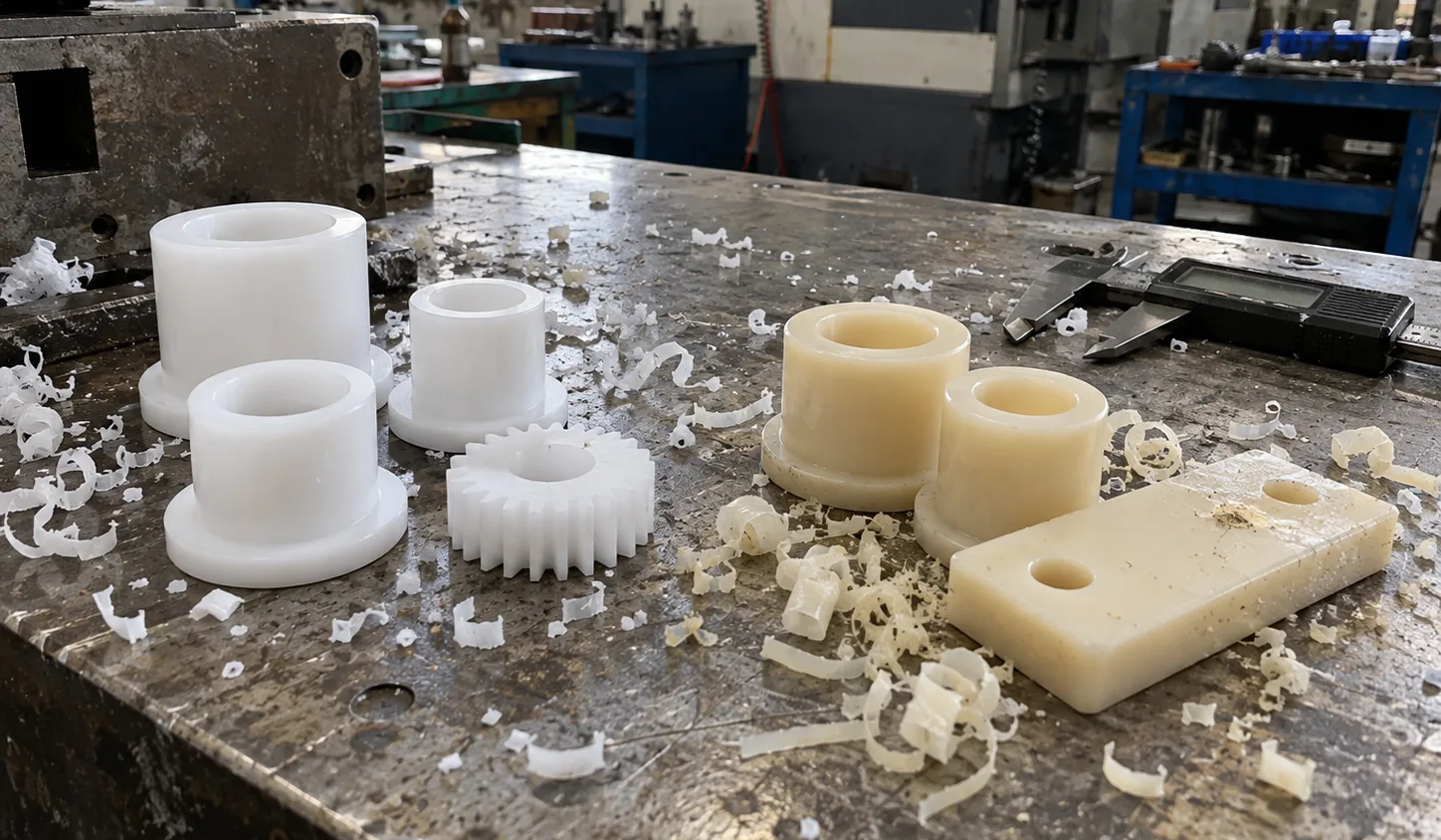
Delrin (acetal, also called POM) and nylon (polyamide, PA) are the two most common engineering plastics for machined bushings, gears, rollers and wear pads, and the right choice between them usually comes down to one question: will the part see moisture while it has to hold size? Delrin absorbs little moisture and stays dimensionally stable, so it suits tight fits. Nylon absorbs moisture, grows and softens as it does, but it gives you more impact resistance, more abrasion resistance and a higher end-use temperature. This guide compares the two for CNC machined parts and shows how to call the grade on an RFQ so the quote matches the material you meant. For the full list of plastics we machine, see our plastic CNC machining materials page.
Delrin vs Nylon: Which Should You Choose?
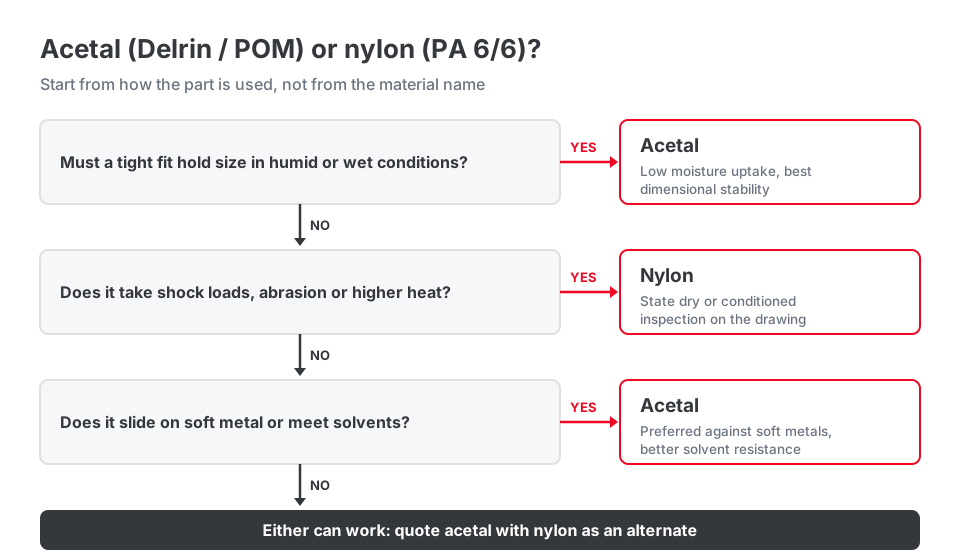
Choose Delrin when dimensional stability, low friction against metal and resistance to solvents matter most. Choose nylon when the part takes shock loads, runs in abrasive conditions, sees higher temperatures, or needs to run quietly. DuPont, which makes both Delrin acetal resin and Zytel nylon resin, gives the same split in its own design guidance for gears, and it maps well onto machined parts. The table summarizes it.
| Property | Delrin / acetal (POM) | Nylon (PA 6/6) |
|---|---|---|
| Dimensional stability | Better. The more stable of the two | Changes size as it absorbs moisture |
| Moisture absorption | Low | Hygroscopic. Takes up moisture from the air until it reaches equilibrium |
| Stiffness and strength in humid conditions | Better. Stiffer and stronger in a humid environment | Strength and stiffness drop as moisture content rises |
| Impact and shock absorption | Good | Better. Highest of the two, and it rises with moisture |
| Abrasion resistance | Good | Better |
| End-use temperature | Lower | Higher |
| Solvent resistance | Better | Good |
| Weak acids and bases | Good | Better |
| Running against soft metals | Preferred | Acceptable |
| Gear noise | Good | Quieter running |
The table is qualitative on purpose. Exact strength, modulus and moisture figures depend on the specific grade, the stock form and the moisture condition at test, so take numbers from the datasheet of the stock you will actually buy rather than from a generic chart.
Is Delrin the Same as Acetal or POM?
Not exactly. Acetal, also called polyoxymethylene or POM, is the material family. It comes in two types: homopolymer (POM-H) and copolymer (POM-C). Delrin is DuPont's trade name for acetal homopolymer. Many other brands sell acetal copolymer, and in everyday shop language all of these get called "Delrin."
This matters on a China RFQ more than on a domestic one. "POM" on a quote tells you the family, not the type, and it does not mean branded Delrin. Both are good machining plastics, but they are not interchangeable on paper. Copolymer and homopolymer have different feed windows, and thick homopolymer stock can carry centerline porosity that matters if your part is bored from the middle of a large rod. If your drawing says "Delrin" and you will accept any acetal, write "acetal (POM-C or POM-H)." If you need homopolymer, write "POM-H" and name the brand only if you truly require it.
How Does Moisture Change Nylon Parts?
All nylons are hygroscopic. BASF's design guide for its Ultramid nylons describes what happens as a part absorbs moisture from the air: impact resistance, toughness and size increase, while strength and stiffness decrease. How fast this happens depends on humidity, temperature and wall thickness. A thick section can take months to reach equilibrium.
For a machined part, that creates two practical problems.
- The part you inspect is not the part in service. A nylon bushing measured dry, straight off the machine, will not measure the same after weeks in a humid assembly plant. State on the drawing whether dimensions apply dry-as-machined or conditioned, so both sides inspect against the same reference.
- Tight fits drift. A press fit or running clearance that works on day one can change as the nylon takes up moisture. If the fit is critical and the environment is humid or wet, acetal is usually the safer choice.
The design convention BASF describes is to base the design on properties at 50% relative humidity and 73 °F, not on dry-as-molded values. Ask for the datasheet values in that condition when you compare grades.
Which Is Better for Bushings, Gears and Wear Parts?
It depends on what the part rubs against and what it has to survive. These are the cases that come up most often on machined plastic RFQs.
Bushings and bearings against a steel shaft
Acetal is the default when the bore has to hold size and the environment is damp. Nylon is the better pick when the bushing takes shock loads or runs in dirt and grit, where its abrasion resistance pays off. Most bushings are turned parts, so our CNC turning service page covers the routing side.
Gears
DuPont's gear guidance notes that running an acetal gear against a nylon gear gives lower wear and friction than either material running against steel, though not always when high loads make heat dissipation the limiting factor. For a pair of machined plastic gears, mixing the two materials is worth considering, especially where lubrication is not allowed. Nylon also runs more quietly.
Wear pads, guides and rollers
Nylon's abrasion resistance makes it a strong choice for guides and wear strips in conveyors and handling equipment. Choose acetal when the part slides against a soft metal, or when a solvent or cleaning agent in the process would affect nylon.
Parts near heat
Between the two, nylon tolerates the higher end-use temperature. If the part runs hotter than either material's datasheet allows, look at a higher-temperature grade instead. Our plastics page compares PEEK and other options.
Which Is Cheaper to Machine, Delrin or Nylon?
There is no single answer, because the price of a machined plastic part is mostly set by stock size, grade, cycle time and inspection, not by the resin alone. Brand, homopolymer or copolymer, and whether the stock size you need is on the shelf can each move the price and the lead time.
The reliable way to compare is to ask for both on the same RFQ: "quote in acetal copolymer, with nylon 6/6 as an alternate." You get a like-for-like price on the same geometry and quantity, and you can decide with real numbers.
How Should You Call the Grade on a China RFQ?
Most plastic quoting problems start with a vague material callout. "White plastic" or "Delrin or similar" leaves the supplier to guess, and the guess is normally the cheapest stock on the shelf. A clear callout includes:
- The family and type: "acetal copolymer (POM-C)", "acetal homopolymer (POM-H)", "nylon 6 (PA6)" or "nylon 6/6 (PA66)".
- Filled or unfilled: say if glass, oil or MoS2 filled grades are required or not allowed.
- Color: natural, white or black, because pigments change appearance and sometimes properties.
- Brand, only if required: "Delrin 100" or another named grade, with "or approved equivalent" if you will accept one.
- Inspection condition for nylon: dry-as-machined or conditioned, as above.
- Any compliance requirement: food contact or other regulatory needs belong on the drawing, because they limit which stock can be quoted.
Our acrylic vs polycarbonate comparison applies the same approach to clear plastics.
What This Means for Your Next Quote
If the part must hold a tight fit in a damp environment, start with acetal. If it takes shock, abrasion or heat, start with nylon, and tell us how it will be inspected. Either way, name the grade precisely, and ask for the other material as an alternate if you are not sure. Send your drawing with the material callout and quantity, and request a quote for both options.