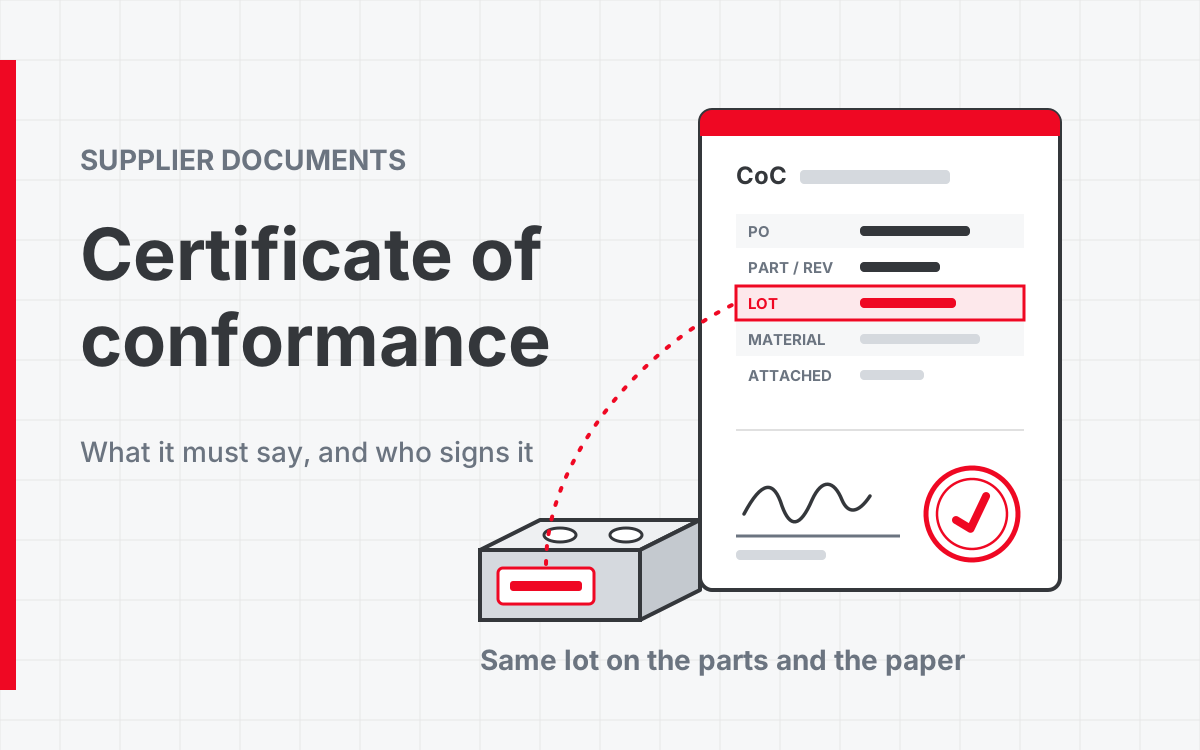
A certificate of conformance (CoC) is a written, signed statement by a supplier that the parts it shipped meet the requirements of your purchase order and drawing. When you buy from an overseas supplier whose shop you may never visit, that signature is often the first piece of paper you check at receiving. This guide covers what a CoC for machined parts must say, how it differs from a mill test report (MTR) and a certificate of analysis (CoA), and what to write into the request for quotation (RFQ) so the right documents arrive with the first shipment. If you are preparing an order now, our CNC machining service page explains how we quote to the revision you release.
The short answer: a CoC is the supplier's signed statement, not the proof. It must name your PO, part number, drawing revision, quantity and lot, and list the evidence behind it. On its own it proves little, so pair it with the inspection report and material certificate you specify in the RFQ.
What Is a Certificate of Conformance (CoC)?
A CoC is the supplier's declaration that its own checks are complete and the shipment conforms. It is a statement, and it usually carries no measured values. What it does carry is accountability: a named company and a named person putting their signature to a specific lot of your parts.
The international standard for this kind of document is ISO/IEC 17050-1, which covers the supplier's declaration of conformity. It treats the declaration as first-party attestation, meaning the supplier vouches for its own product. If the declaration points to test results from a lab or another party, that does not reduce the supplier's own responsibility. For metal materials, EN 10204 has a close equivalent: a type 2.1 "declaration of compliance with the order", validated by the manufacturer, with no test results attached.
Is a certificate of compliance the same as a certificate of conformance?
In practice the two names are used loosely, and often interchangeably. "Compliance" tends to be used against a regulation, such as a RoHS declaration, and "conformance" against a specification or an order. Read what the document actually states and which requirements it names, not the title at the top.
What Must a CoC for Machined Parts Include?
A useful certificate of conformance ties one shipment to one lot, one drawing revision and one authorized person. The fields below are a sensible minimum for CNC-machined parts.
| Field | What it should say | Why it matters |
|---|---|---|
| Supplier name and address | The company that made and released the parts | Shows who is responsible. A trading company's certificate without the manufacturer's name hides who did the work |
| Certificate number and date | A unique reference and the issue date | Lets you file the document and ask the supplier for the records behind it |
| Your PO number and line item | The PO number exactly as you issued it | Confirms the certificate belongs to your order, not to a generic file |
| Part number and drawing revision | Your part number and the revision you released | A certificate against an old revision says nothing about the parts you ordered |
| Quantity and lot or batch ID | The piece count and the supplier's lot identifier | Lets you match the paper to the parts and their box labels |
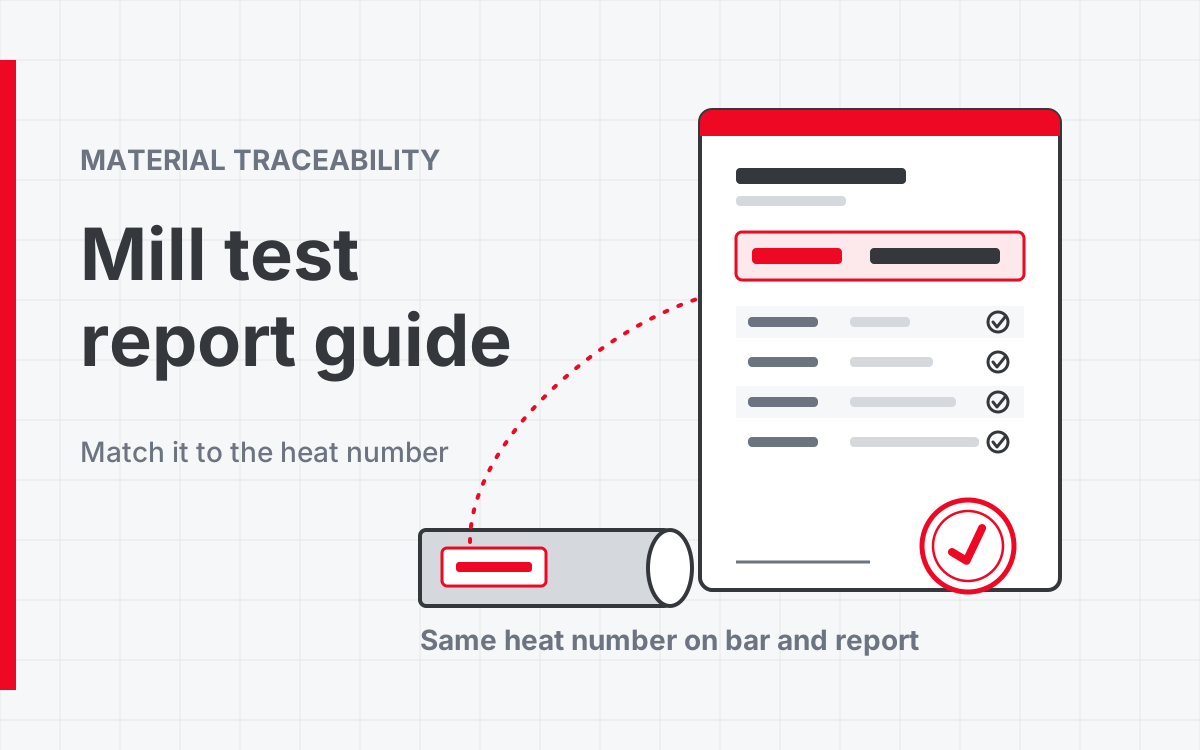
| Material grade and standard, with heat or lot number | For example "6061-T6 aluminum" with the heat number from the material certificate | Connects the parts to the mill's data. The shop copies this number from the certificate rather than creating it |
| Finish and process specifications | The anodize, plating or heat treatment specification called on your drawing | Confirms each process was done to the specification you named |
| Conformance statement | Which requirements it covers: drawing, PO and any named specifications | "Conforms to drawing" with no revision is incomplete |
| Attached evidence | A list of the inspection report, material certificate and finish certificate supplied | The CoC is the signature and these are the proof. All of them should arrive together |
| Deviations or concessions | Any deviation you approved, by reference number, or "none" | Makes any approved exception visible instead of buried in an email |
| Authorized signature | Printed name, role, signature and date | ISO 9001 quality systems keep traceability to the person who authorized release |
A certificate of conformance template downloaded from the internet is a starting point only. Every field has to be filled from the actual job. A CoC that says "parts conform to drawing" with no revision, lot or attachments tells you very little about what is in the box.
What Is the Difference Between a CoC, an MTR and a CoA?
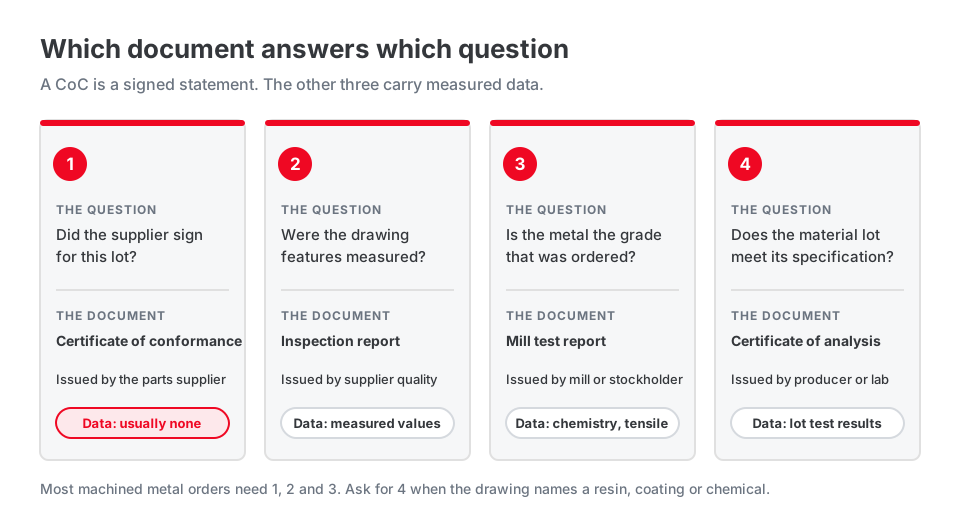
A CoC is a statement, while an inspection report, an MTR and a CoA each carry measured data. They answer different questions, so most orders of machined metal parts need more than one of them.
| Document | Issued by | What it proves | Measured data? | Typical use |
|---|---|---|---|---|
| Certificate of conformance (CoC) | The machine shop or parts supplier | The supplier checked the parts against your PO and drawing and found them conforming | Usually none. It lists attachments | Every shipment of machined parts |
| Inspection report or first article report | The supplier's quality team | Specific features were measured, with results against the drawing tolerances | Yes, measured values per feature | First articles, critical features, or a full layout as agreed |
| Mill test report (MTR) | The mill, or a stockholder passing the mill's data along | Chemistry and mechanical properties for one heat of metal | Yes, chemistry and tensile results | Material traceability for metal parts |
| Certificate of analysis (CoA) | The material producer or a testing laboratory | A specific lot or batch of material meets its specification | Yes, test results against the specification | Plastic resins, coatings, chemicals and other processed materials |
The coc vs coa question comes down to statement versus data. A buyer of machined metal parts usually needs a CoC plus an MTR, while a CoA matters more when the drawing names a plastic resin, a coating or a chemical. Our mill test report guide explains the EN 10204 certificate types and how to read the heat number, so this article does not repeat them.
Who Issues a Certificate of Conformance, and Who Signs It?
The company that made and released the parts issues the CoC. For machined parts that is the machine shop, not the mill: the mill issues the MTR for the material, and the shop issues the CoC for the machining. If a trading company or agent ships your parts, ask whose certificate it is and ask for the manufacturer's. A company that did not machine the parts cannot attest to how they were machined.
The CoC should be signed by the person authorized to release product, which usually means quality, not sales. ISO 9001 (clause 8.6) says product should not be released until the planned checks are complete, and it asks for records showing conformity and traceability to the person who authorized the release. A certification body issues a different kind of document, a product certificate based on its own testing. You only need one of those when a regulation or your own customer asks for it.
Is a CoC Enough, or Do You Also Need an Inspection Report?
For prototypes and non-critical parts, a CoC is often enough. For production parts with critical features, ask for a CoC backed by an inspection report with measured values for those features, plus the material certificate. Match the package to what a wrong part would cost you.
- Prototype, fixture and non-critical parts: a CoC that states the material grade, with your own check at receiving.
- Production parts with critical features: a CoC, an inspection report with measured values for the critical dimensions, and an MTR with the heat number traced to the lot.
- Automotive parts under a customer quality program: the production part approval process (PPAP) level your customer names decides the package. The part submission warrant (PSW) is the supplier's signed declaration, backed by elements such as dimensional results and material test records.
"Conforms" is only as good as the inspection behind it. The UK National Physical Laboratory's dimensional metrology guidance makes the point that measurement uncertainty counts against the party proving conformance. A supplier who signs a CoC should be able to show a measured result that sits inside the tolerance with room for that uncertainty, so on tight features ask how and with what equipment they were measured.
How Do You Check a CoC From an Overseas Supplier Before Accepting Parts?
When you cannot walk the shop floor, the paperwork is your evidence. Run the same six checks on every shipment. They take a few minutes and catch most problems before the parts reach your line.
1. Match the PO, part number and revision
Check the PO number against your own system. Then confirm that the part number and drawing revision on the CoC are exactly the ones you released. A certificate written against an earlier revision is one of the most common paperwork errors.
2. Match the quantity and lot to the packing list and labels
The quantity and lot ID on the CoC should match the packing list and the labels on the boxes. A mismatch points to mixed lots or a certificate copied from another shipment, and both are worth a question before you accept the parts.
3. Follow the material line to a certificate and a heat number
The CoC should state the material grade, the standard and the heat or lot number. Find the attached material certificate and confirm it names the same heat number. The shop cannot issue an MTR itself. What it can do is link your parts to the mill's data.
4. Check that every referenced attachment arrived and names the same lot
If the CoC lists an inspection report, a material certificate and a finish certificate, all three should be in the package. Each should name the same part number, revision and lot. A listed attachment that never arrived is a reason to hold the parts until it does.
5. Check the signature, the role and the date
Look for a printed name, a role, a signature and a date. A company stamp with no name gives you nobody to ask. The date should fall after final inspection and before shipment, not months earlier.
6. Watch for a generic certificate
Some certificates are filled in once and reused. Warning signs are identical wording and numbers across different shipments, no revision, blank fields, or "per drawing" with nothing attached. Any of these suggests the CoC was not written for this job.
None of these checks implies distrust of a particular supplier. They are normal receiving-inspection habits, adjusted for the distance between your desk and the machine.
What Should Your RFQ and PO Say About Certificates of Conformance?
The buyer has to say which documents it expects, and the RFQ is the place to say it. ISO 9001 (clause 8.4.3) expects the buying organization to tell its suppliers its requirements for approving and releasing product. European material standards such as EN 10130 and EN 10088 work the same way: the inspection document is agreed at enquiry and order. If the RFQ is silent, you have little basis for rejecting a thinner document later.
Put these lines in the RFQ or in the drawing notes:
- A CoC with each shipment, naming the PO, part number, revision, quantity and lot.
- The CoC signed by the supplier's quality representative, with printed name and role.
- The material certification you need and heat number traceability to the lot, written the way our MTR guide describes.
- The inspection report scope (first article, critical features or full layout) and its format.
- Finish or process certificates wherever the drawing calls out a specification.
- When the documents arrive: with the shipment, or before shipment for your review.
Our guide to submitting a CNC machining RFQ to China covers the rest of the RFQ package. Certificates of conformance belong in the same first message as the drawing and quantity, because the document list can change what a supplier quotes.
What This Means for Your Next Quote
The CoC is the signature, and the inspection report and material certificate are the proof. All three belong in the RFQ, not in a request after the first shipment. On our side, ballooned drawings with a dimension-by-dimension report are produced on our own CMMs, and mill certificates and heat- or lot-level traceability are available as quoted scope. Tell us at RFQ which documents your PO needs, and we will confirm before the order what comes with the parts. Request a quote with your drawing, revision and document list.