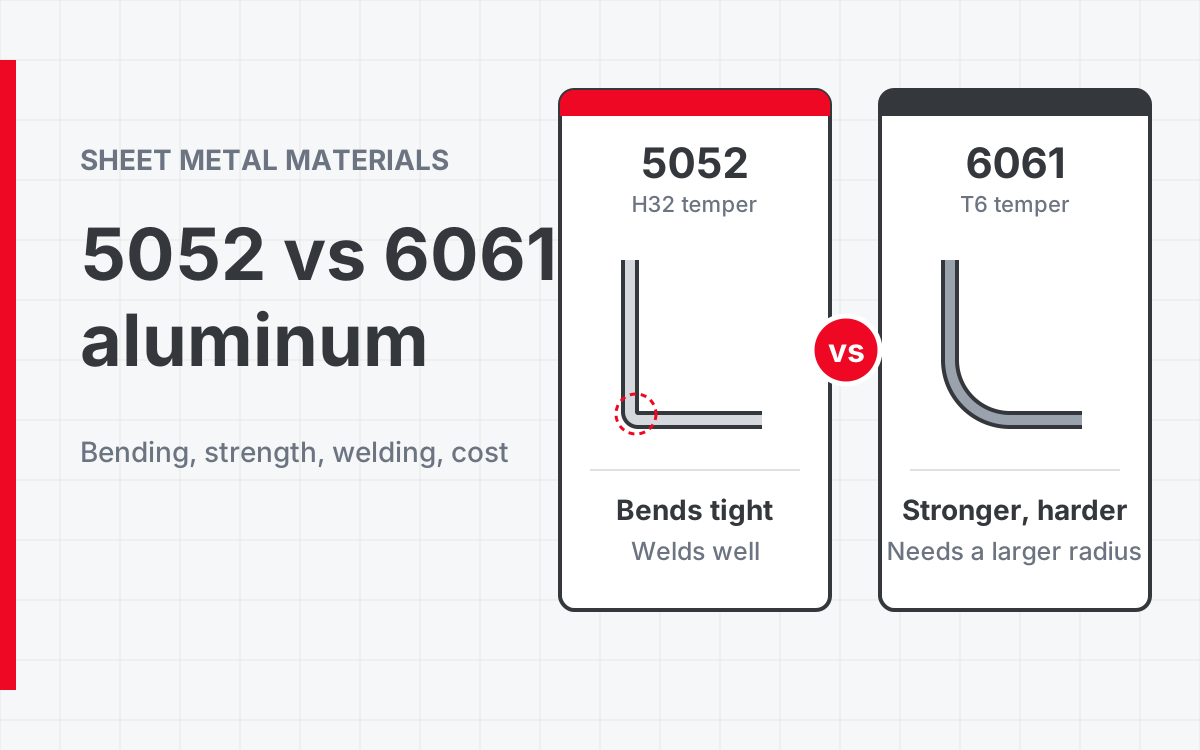
5052 and 6061 are the two aluminum alloys that show up most often on sheet metal drawings, and they suit different parts. 5052-H32 is the forming and welding alloy: it takes tight bends and keeps more of its strength next to a weld. 6061-T6 is the stronger, harder, heat-treated alloy. It machines better, but it needs a generous bend radius and loses a large share of its strength where it is welded. The temper after the dash matters as much as the alloy number, so this guide compares the two as they are actually bought, 5052-H32 and 6061-T6, and shows how to call them on a drawing. For the fabrication side, see our sheet metal fabrication service.
The short answer: choose 5052-H32 for enclosures, covers, brackets with several bends, welded boxes and outdoor or coastal equipment. Choose 6061-T6 for flat or lightly formed plates that carry more load, parts with machined features, and parts where hardness matters. Whichever you choose, write the temper on the drawing. "Aluminum" or "Al 6061" on its own leaves the supplier to guess.
What Is the Difference Between 5052 and 6061 Aluminum?
The difference is how each alloy gets its strength. 5052 is an aluminum-magnesium alloy that cannot be heat treated. It is strengthened by cold work, which is what the "H" tempers describe, and H32 means strain-hardened and stabilized to a quarter-hard condition. Because its strength comes from cold work, 5052 has no T6 temper and cannot be heat treated to one.
6061 is an aluminum-magnesium-silicon alloy with a small copper addition, and it is heat-treatable. T6 means solution heat-treated and then artificially aged. T4 means solution heat-treated and naturally aged, and O means annealed (fully soft). The T6 condition gives 6061 its strength and hardness, and it is also what makes tight forming difficult.
| Property (typical, sheet) | 5052-H32 | 6061-T6 |
|---|---|---|
| Alloy family | Aluminum-magnesium (2.5% Mg nominal) | Aluminum-magnesium-silicon (1.0% Mg, 0.6% Si nominal) |
| How it gets its strength | Cold work (strain hardening). Not heat-treatable | Solution heat treatment and artificial aging |
| Ultimate tensile strength | 33 ksi (230 MPa) | 45 ksi (310 MPa) |
| Yield strength | 28 ksi (195 MPa) | 40 ksi (275 MPa) |
| Elongation (sheet test) | 12% | 12% |
| Brinell hardness | 60 | 95 |
| Modulus of elasticity | 10.2 million psi (70 GPa) | 10.0 million psi (69 GPa) |
| Density | 0.097 lb/in³ | 0.098 lb/in³ |
| Cold workability | B | C (B in T4, A in O) |
| Arc weldability | A | A |
| General corrosion resistance | A | B |
| Machinability | D | C |
Strength, hardness, modulus and density are typical handbook values, not guaranteed minimums. For acceptance, use the minimum values of the material standard named on your drawing. The letter ratings come from the Aluminum Design Manual's comparative table, where A is best.
How Much Stronger Is 6061-T6 Than 5052-H32?
6061-T6 has about 40 percent higher yield strength than 5052-H32: 40 ksi (275 MPa) against 28 ksi (195 MPa). Its ultimate tensile strength is about 35 percent higher, at 45 ksi (310 MPa) against 33 ksi (230 MPa), and it is noticeably harder, at 95 HB against 60 HB. Both show 12 percent elongation in the standard sheet test, so the gap in formability does not come from elongation alone.
Three points are often missed when buyers switch alloys to "get a stronger part":
- Stiffness does not change. The modulus is 10.0 million psi for 6061 and 10.2 million psi for 5052. A panel that flexes too much in 5052 will flex the same amount in 6061. Thickness, flanges and ribs fix stiffness. The alloy does not.
- Fatigue is not automatically better. The handbook endurance limit is 17 ksi (115 MPa) for 5052-H32 and 14 ksi (95 MPa) for 6061-T6. For a bracket under vibration, higher static strength does not mean longer life.
- Weight is the same. Density is 0.097 lb/in³ for 5052 and 0.098 lb/in³ for 6061, so changing alloy will not change part weight in any useful way.
Does 5052 Bend Better Than 6061-T6?
Yes. The Aluminum Design Manual rates cold workability B for 5052-H32 and C for 6061-T6, and 6061-T6 tends to crack on the outside of a tight bend. Softer 6061 tempers form much better, with T4 rated B and O rated A. The Aluminum Association's general guidance is that the minimum bend radius depends on the alloy, temper, thickness and bending method, and that harder tempers and thicker sheet need larger radii.
Grain direction matters as well. Rolled sheet bends most reliably when the bend line runs across the rolling direction. Bends parallel to the rolling direction are the ones most likely to crack, so mark the grain on the flat pattern if a tight bend must not crack. Aluminum also has a low modulus, so it springs back and has to be overbent to hold the angle.
If the part must be 6061-T6
You have three practical routes, and each one belongs on the drawing:
- Use a generous inside radius and have the fabricator confirm it for the thickness before the order.
- Form soft, then heat treat. Bend in the O or T4 temper and artificially age the part to T6 afterwards. This adds a heat-treatment step, and the part needs a flatness check after aging.
- Form in T6 at a confirmed radius only, accepting a larger radius than the same part in 5052.
In every case, put the inside bend radius on the drawing and ask for it to be confirmed for the alloy, temper and thickness. A radius that is agreed before the quote costs nothing. A radius that is discovered at the first article costs a remake.
Which Is Easier to Weld and Anodize, 5052 or 6061?
5052 is easier to weld without losing strength, and 6061 usually gives the better anodized finish. Both alloys are classed as readily weldable by gas metal arc (MIG) and gas tungsten arc (TIG) welding. The difference is what happens beside the weld.
Welding
Welding locally anneals the metal next to the bead. Non-heat-treatable alloys such as 5052 lose less strength this way, because the weld zone only drops toward the annealed values (5052-O has a typical ultimate strength of 28 ksi, against 33 ksi for H32). 6061-T6 loses much more, because the heat over-ages it. In one published MIG test with ER4043 filler, the heat-affected zone of 6061-T6 measured about 183 MPa ultimate against 310 MPa for the base metal, and another study measured a 41 percent drop. Restoring T6 strength means a full solution heat treatment and aging of the welded part, which is rarely practical on a fabricated assembly.
So if a weld carries load, design it around as-welded strength, or choose 5052. The common filler families are 4043 and 5356. Name the filler on the drawing, or ask the fabricator to propose one before quoting.
Anodizing and corrosion
The 6xxx alloys have an excellent response to anodizing. 5052 anodizes too, but it tends to look yellowish in thicker coatings. When two alloys sit side by side on a cosmetic assembly, the color can differ, so keep one alloy per visible assembly or approve a sample first. Hard anodize on 6061 comes out tan or grey and darkens as the coating gets thicker.
For corrosion, the Aluminum Design Manual rates general resistance A for 5052 and B for 6061-T6, with both rated A for stress-corrosion cracking. That is why 5052 is a common choice for outdoor and coastal enclosures.
Which Costs More, 5052 or 6061 Sheet?
There is no fixed answer, because sheet price depends on the mill, thickness, temper and the stock that is available when you order. Compare real quotes rather than list prices. On a finished part, process cost often outweighs the price difference between the two alloys.
A 6061-T6 part with tight bends may need forming in T4 or O and heat treatment afterwards, extra design work on radii, or scrap from cracked bends. In the other direction, 6061 machines better (rated C against D for 5052-H32), which saves time when the part has milled pockets, countersinks or tapped holes. The reliable way to compare is to ask for both on one RFQ: "quote in 5052-H32, with 6061-T6 as an alternate."
When Should a Sheet Metal Part Be 5052-H32, and When 6061-T6?
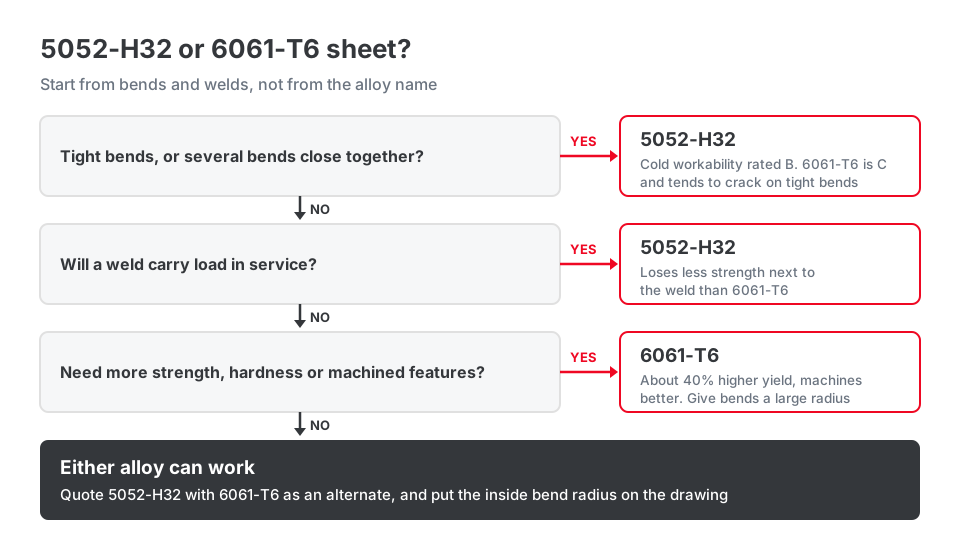
Choose by what the part has to survive, not by which alloy sounds stronger. These are the cases that come up most often.
Choose 5052-H32 for:
- Enclosures, chassis, covers and panels
- Brackets with several bends or tight radii
- Welded boxes, trays and tanks
- Outdoor and coastal equipment
Choose 6061-T6 for:
- Flat or lightly formed plates
- Mounting plates and brackets that carry higher load
- Parts with machined features after forming
- Parts where hardness and dent resistance matter
How Should You Call 5052 or 6061 on a Drawing Sent to a China Fabricator?
Write the alloy and the temper together, and name the material standard. A vague callout is how a sheet metal quote ends up priced on a different material from the one you meant. A complete callout covers:
- Alloy and temper: "5052-H32" or "6061-T6", never "aluminum" or "Al 6061" on its own.
- The standard: ASTM B209 covers aluminum sheet and plate in the US. Chinese mills sell the same four-digit alloys, with chemical composition to GB/T 3190 and sheet properties to the GB/T 3880 series. In Europe the names are EN AW-5052 and EN AW-6061 under EN 485-2. Say which standard the material certificate must reference.
- Thickness in mm or inches: give the gauge only as a reference. Our sheet metal gauge chart shows why aluminum gauges differ from steel.
- Inside bend radius: and the bend direction relative to the grain, if it matters.
- Forming and heat treatment: if 6061 will be formed soft and aged afterwards, write "form in T4, age to T6 after forming", and state how the final temper is verified (a hardness check or a test coupon).
- Finish: anodize type and color, and whether a sample must be approved first.
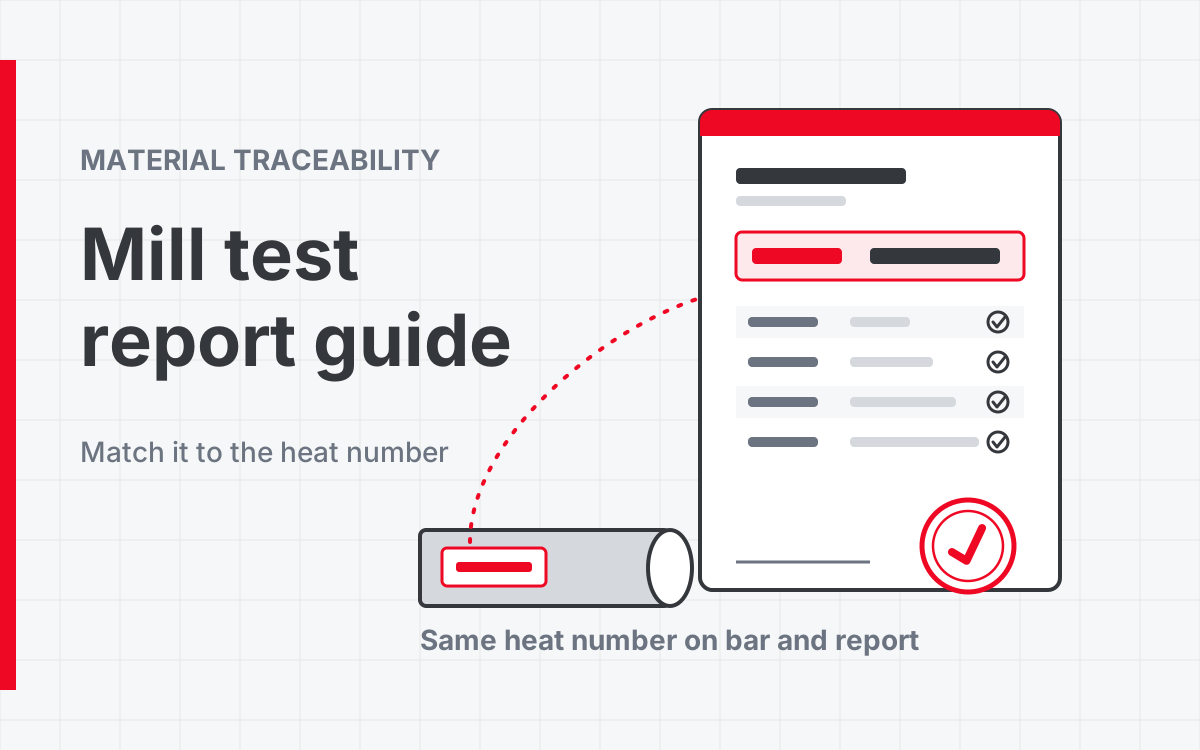
- Material certificate: ask for the mill certificate showing alloy, temper and standard. Our mill test report guide covers what to check on it.
We do not substitute sheet stock silently. If an alternate grade or temper would help, we confirm it against your drawing before material is ordered.
What This Means for Your Next Quote
If the part has tight bends or load-bearing welds, start with 5052-H32. If it is flat or lightly formed and needs strength, hardness or machined features, start with 6061-T6 and give it a radius it can take. Either way, write the alloy, temper, standard, inside radius and finish on the drawing, and ask for the other alloy as an alternate if you are not sure. Send your drawing and quantity, and request a quote for both options.