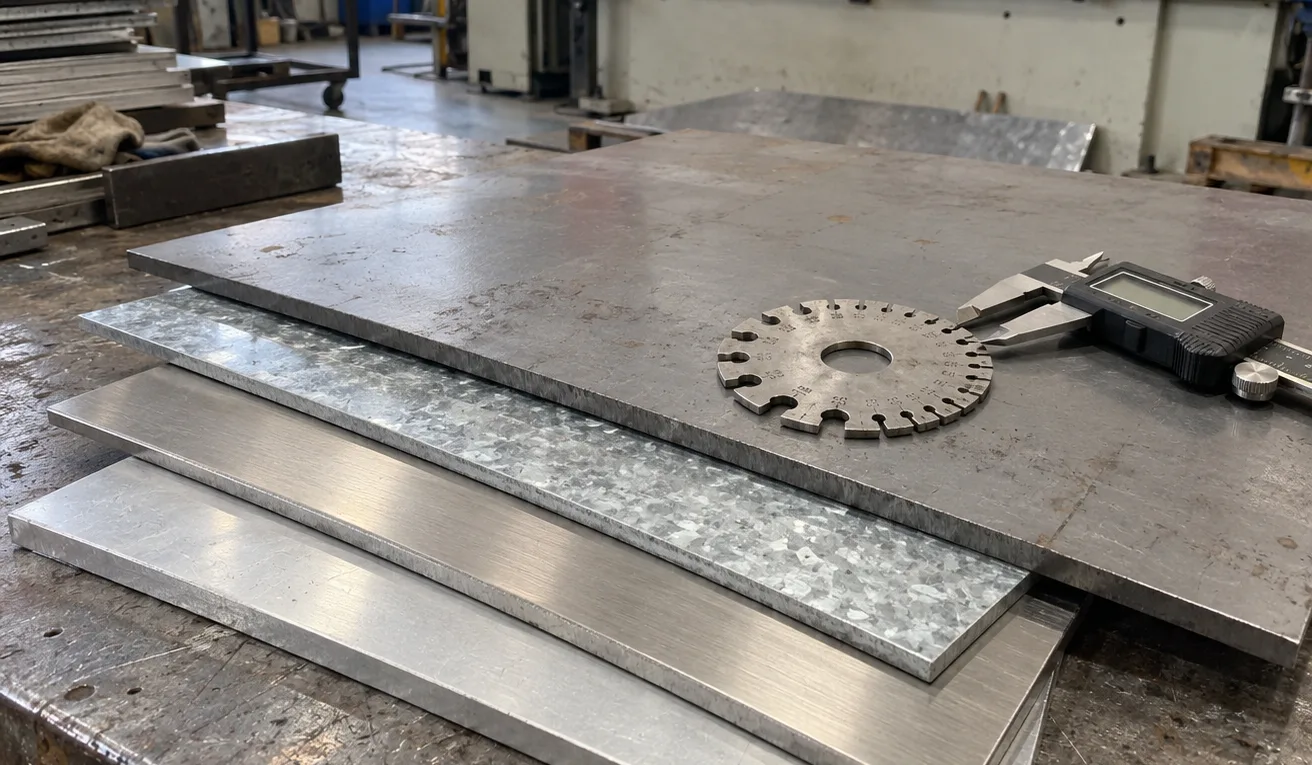
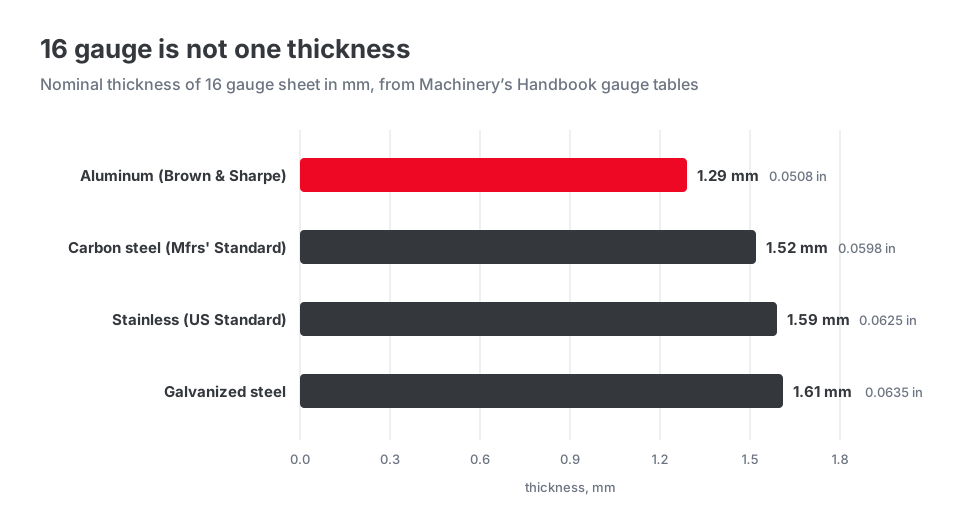
A sheet metal gauge chart converts a gauge number into an actual thickness, and the key fact is that the same gauge number means a different thickness for each material. 16 gauge steel is 0.0598 in (1.52 mm), 16 gauge galvanized steel is 0.0635 in (1.61 mm), 16 gauge stainless is 0.0625 in (1.59 mm) and 16 gauge aluminum is 0.0508 in (1.29 mm). The chart below gives inch and millimeter values for gauges 8 to 28 in all four. Below it, we explain why the systems differ and why a drawing sent to a sheet metal fabrication supplier should call thickness in millimeters or inches rather than gauge alone.
Sheet Metal Gauge Chart: Steel, Galvanized, Stainless and Aluminum
Values are nominal thickness. Millimeters are converted at 25.4 mm per inch and rounded to 0.01 mm. Actual sheet varies within the thickness tolerance of the material standard it is produced to, so treat these as nominal sizes, not inspection limits.
| Gauge | Steel (in) | Steel (mm) | Galvanized (in) | Galvanized (mm) | Stainless (in) | Stainless (mm) | Aluminum (in) | Aluminum (mm) |
|---|---|---|---|---|---|---|---|---|
| 8 | 0.1644 | 4.18 | 0.1681 | 4.27 | 0.1719 | 4.37 | 0.1285 | 3.26 |
| 9 | 0.1495 | 3.80 | 0.1532 | 3.89 | 0.1562 | 3.97 | 0.1144 | 2.91 |
| 10 | 0.1345 | 3.42 | 0.1382 | 3.51 | 0.1406 | 3.57 | 0.1019 | 2.59 |
| 11 | 0.1196 | 3.04 | 0.1233 | 3.13 | 0.1250 | 3.18 | 0.0907 | 2.30 |
| 12 | 0.1046 | 2.66 | 0.1084 | 2.75 | 0.1094 | 2.78 | 0.0808 | 2.05 |
| 13 | 0.0897 | 2.28 | 0.0934 | 2.37 | 0.0937 | 2.38 | 0.0720 | 1.83 |
| 14 | 0.0747 | 1.90 | 0.0785 | 1.99 | 0.0781 | 1.98 | 0.0641 | 1.63 |
| 15 | 0.0673 | 1.71 | 0.0710 | 1.80 | 0.0703 | 1.79 | 0.0571 | 1.45 |
| 16 | 0.0598 | 1.52 | 0.0635 | 1.61 | 0.0625 | 1.59 | 0.0508 | 1.29 |
| 17 | 0.0538 | 1.37 | 0.0575 | 1.46 | 0.0562 | 1.43 | 0.0453 | 1.15 |
| 18 | 0.0478 | 1.21 | 0.0516 | 1.31 | 0.0500 | 1.27 | 0.0403 | 1.02 |
| 19 | 0.0418 | 1.06 | 0.0456 | 1.16 | 0.0437 | 1.11 | 0.0359 | 0.91 |
| 20 | 0.0359 | 0.91 | 0.0396 | 1.01 | 0.0375 | 0.95 | 0.0320 | 0.81 |
| 21 | 0.0329 | 0.84 | 0.0366 | 0.93 | 0.0344 | 0.87 | 0.0285 | 0.72 |
| 22 | 0.0299 | 0.76 | 0.0336 | 0.85 | 0.0312 | 0.79 | 0.0253 | 0.64 |
| 23 | 0.0269 | 0.68 | 0.0306 | 0.78 | 0.0281 | 0.71 | 0.0226 | 0.57 |
| 24 | 0.0239 | 0.61 | 0.0276 | 0.70 | 0.0250 | 0.64 | 0.0201 | 0.51 |
| 25 | 0.0209 | 0.53 | 0.0247 | 0.63 | 0.0219 | 0.56 | 0.0179 | 0.45 |
| 26 | 0.0179 | 0.45 | 0.0217 | 0.55 | 0.0187 | 0.48 | 0.0159 | 0.40 |
| 27 | 0.0164 | 0.42 | 0.0202 | 0.51 | 0.0172 | 0.44 | 0.0142 | 0.36 |
| 28 | 0.0149 | 0.38 | 0.0187 | 0.47 | 0.0156 | 0.40 | 0.0126 | 0.32 |
Sources: steel and galvanized values follow the Manufacturers' Standard Gage for Sheet Steel and the Galvanized Sheet Gage as tabulated in Machinery's Handbook, 31st edition. Stainless values follow the same handbook's sheet metal gauge conversion chart, which uses the US Standard Gage fractions. Aluminum values follow the American (Brown & Sharpe) gauge. Every value was cross-checked against a second published gauge table, the Starrett gauge reference, and two transcription errors in one source were corrected against the other.
Why Does the Same Gauge Mean Different Thicknesses?
Gauge is not a unit of length. It is an index number, and each material family grew up with its own index.
- Carbon steel uses the Manufacturers' Standard Gage for Sheet Steel. Its thicknesses are based on steel weighing 41.82 lb per square foot per inch of thickness.
- Stainless steel is commonly listed on the older US Standard Gage, which Congress set in 1893 as a weight gauge based on wrought iron at 40 lb per square foot per inch. Its values fall on simple fractions, so 16 gauge is exactly 1/16 in.
- Galvanized steel uses the Galvanized Sheet Gage, which takes the US Standard Gage weight and adds a fixed 2.5 oz per square foot for the coating. That is why galvanized sheet is thicker than bare steel of the same gauge number.
- Aluminum and other non-ferrous sheet usually follow the American, or Brown & Sharpe, gauge, the same series used for American wire gauge.
Because the steel and stainless gauges started as weight measures, the thickness for a given number depends on the density the system assumed. A gauge number only becomes a thickness once you know which system it belongs to.
Why does a higher gauge number mean thinner sheet?
In every one of these systems the number counts down as the material gets thicker, so 10 gauge is heavier than 20 gauge. Read the number as a position in a list, not as a size. The steps are also uneven: in the steel gauge, moving from 10 to 11 removes about 0.38 mm, while moving from 26 to 27 removes about 0.04 mm.
Is Gauge Thickness the Same for Steel and Aluminum?
No, and the difference is large enough to change a part. At 16 gauge, aluminum is about 0.23 mm thinner than carbon steel, and about 15% thinner in relative terms. At 10 gauge, the gap grows to about 0.83 mm. A design converted from steel to aluminum by keeping the gauge number will come out thinner and less stiff than intended.
Stainless sits in between. On the US Standard Gage it runs slightly thicker than carbon steel of the same gauge number. Not every published chart treats stainless the same way, which is one more reason a gauge number alone is not enough.
What Gauge Is 1 mm Sheet Metal?
None of the gauge systems has a value at exactly 1.00 mm. The nearest values are:
- Steel: 19 gauge (1.06 mm) or 20 gauge (0.91 mm)
- Galvanized: 20 gauge (1.01 mm)
- Stainless: 20 gauge (0.95 mm)
- Aluminum: 18 gauge (1.02 mm)
This works the other way too. Metric material standards order flat products by nominal thickness against a dimensional standard. The European standard for cold-rolled low-carbon steel, EN 10130, asks the purchaser for the nominal dimensions and tolerances under its dimensional standard, EN 10131. A supplier who buys metric stock will therefore turn your gauge into the nearest metric thickness it can buy. If that guess is wrong, the part comes back too thin or too heavy, and the bend allowances in your flat pattern no longer match.
Should You Specify Gauge or mm on a Sheet Metal Drawing?
Specify thickness as a dimension in millimeters or inches, and add the gauge in brackets only as a reference if your team is used to it. A note such as "MATERIAL: 304 STAINLESS, 1.5 mm (REF. 16 GA)" tells the supplier exactly what to buy and still reads naturally to someone who thinks in gauge.
Add three more things to make the callout complete:
- The material grade and standard. Thickness tolerance comes from the material's dimensional standard, so naming it fixes the tolerance as well. For stainless flat products, EN 10088-2 points to EN ISO 9444-2 for continuously rolled strip and plate, and to EN ISO 18286 for individually rolled plate.
- A tighter thickness tolerance, if you need one. If a fit or a flatness requirement depends on thickness, put the tolerance on the drawing rather than relying on the standard's default.
- Whether a substitute thickness is acceptable. Say so if the nearest stocked metric size is fine. If it is not, say that too, so the supplier quotes the exact size or asks before ordering.
Thickness also drives much of the price. It sets stiffness, weld heat input and how hard edges can be deburred, and it decides how many parts nest on a sheet. Our sheet metal fabrication cost guide covers how gauge and grade move a quote.
How Do You Convert Gauge to mm Correctly?
Use this sequence every time, and gauge-to-metric errors disappear.
- Identify the material: carbon steel, galvanized, stainless or aluminum.
- Read the inch value from the right column of the chart for that material.
- Multiply by 25.4 to get millimeters.
- Pick the nearest stocked metric thickness, and check that the difference is acceptable for stiffness, fit and your bend allowances.
- Write the metric thickness on the drawing as the controlling dimension.
For machined features added to sheet parts after forming, such as counterbores or tapped holes, see our metal materials page for how to call out the alloy itself.
What This Means for Your Next Quote
A gauge number is a convenient shorthand inside one shop. Across a supply chain, and especially across the metric and imperial divide, it becomes a source of wrong-thickness parts. Call thickness in millimeters or inches, keep the gauge as a reference, and name the material standard so the tolerance is settled. Send your flat pattern or 3D model with the thickness, grade and finish, and request a quote for your sheet metal parts.