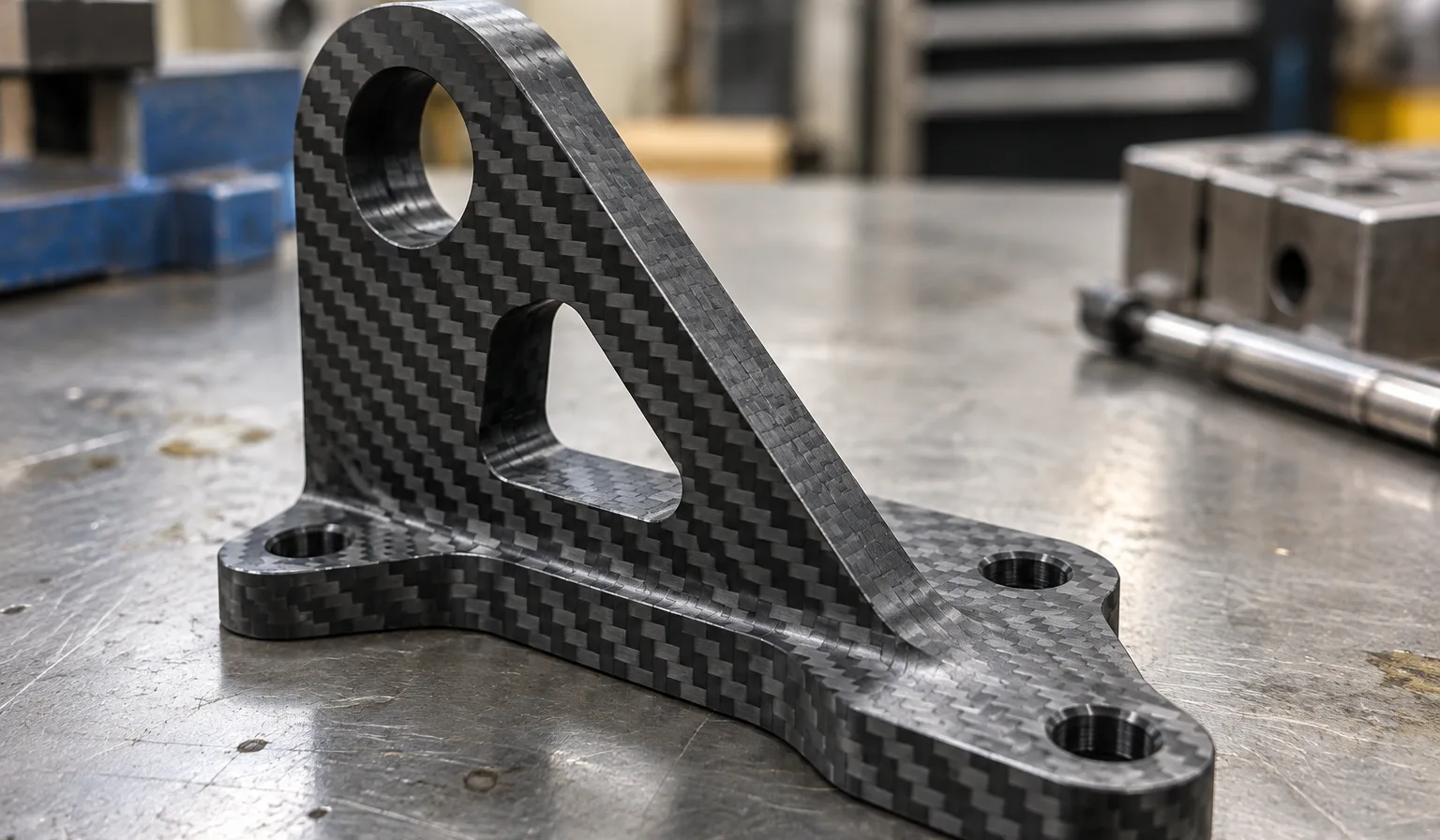
Carbon fiber doesn't cut like metal, and treating it like a lightweight aluminum substitute on the machine is how a part comes off the table delaminated, fuzzy-edged, or out of tolerance. It's a fiber-reinforced composite, not a homogeneous material — the cutting tool is shearing glass-hard carbon fibers and a polymer resin at the same time, and the two fail completely differently. Four things drive whether a CFRP part machines clean: tooling, fiber orientation, dust control, and where the part actually needs 5-axis access.
Why Carbon Fiber Isn't "Machined" the Way Metal Is
It's abrasive, not just hard. Carbon fiber reinforcement is closer in cutting behavior to an abrasive ceramic than to a metal — conventional carbide tooling wears fast against it, the same failure mode seen machining other hard-particle composites. Standard practice for abrasive fiber-reinforced materials is PCD, diamond-tipped, or CVD diamond-coated tooling rather than uncoated carbide, specifically because the fibers themselves — not the resin — do the abrasive damage to the cutting edge.
Fiber orientation, not just feed rate, decides edge quality. Whether an edge delaminates depends heavily on the angle the fibers meet the cutter at, especially on drilled and trimmed edges — a hole drilled against the grain of the outer plies is a materially different risk than one drilled with it. This is a property of the layup, not something feed and speed alone can fully engineer around.
Heat has nowhere good to go. The epoxy resin matrix is thermally sensitive in a way aluminum isn't — push cutting temperature too high and the resin softens or degrades locally before the fiber itself is affected, which shows up as edge fuzz or matrix burn rather than a clean cut.
See our carbon fiber machining capability for the grades and layups we run.
Tooling — Why This Isn't a Standard End Mill Job
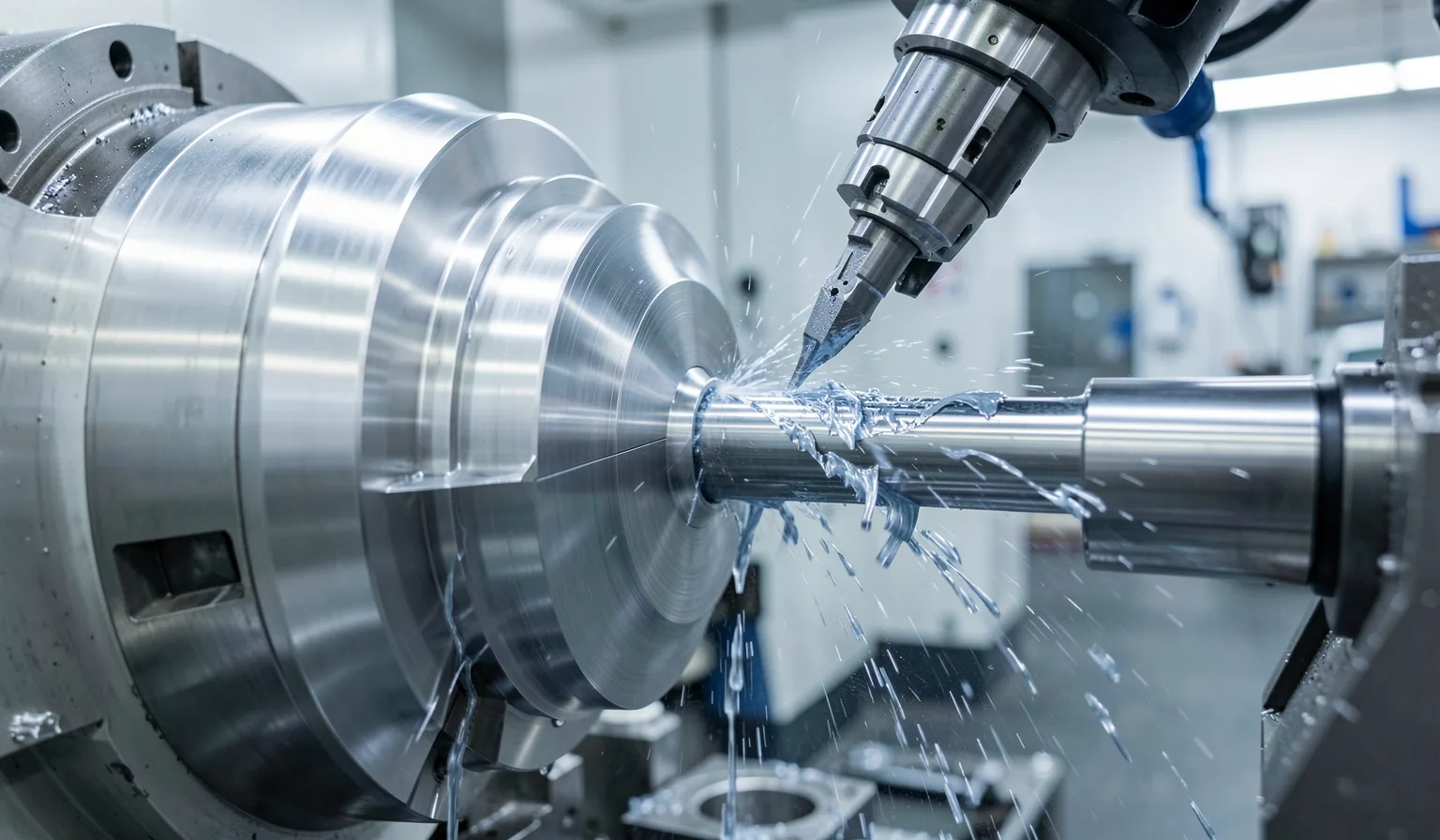
Diamond-coated and PCD (polycrystalline diamond) tooling is the standard recommendation for CFRP and graphite composites specifically because uncoated carbide wears too fast against the fiber reinforcement to hold a clean edge across a production run. CVD diamond coatings are marketed by cutting-tool makers explicitly for "the toughest and most abrasive components made from graphite and CFRP" — this isn't a niche recommendation, it's the standard tooling category for the material.
Best fit: any CFRP part where edge quality matters — trimmed profiles, drilled holes, machined features on a cured laminate.
Drilling and Trimming — Where Delamination Actually Happens
Holemaking operations are typically the highest-risk cuts on a composite part. Delamination — the fiber plies separating from the resin matrix at the cut edge — is a real concern in drilling, especially on through-holes, and it's driven by the bond strength between fiber and matrix as much as by process parameters. Feed rate matters more here than on most metals: too light a feed lets the tool rub instead of shear, which is exactly the condition that promotes delamination and fiber pull-out rather than a clean cut.
Best fit: parts with tight edge-quality requirements at drilled or trimmed features should be called out on the drawing — not left as an assumed default — since the process response (feed, tool geometry, backing/support at the exit face) differs from what a metal part drawing would specify.
Dust Control — A Process Requirement, Not a Housekeeping Afterthought
Machining CFRP generates predominantly respirable dust — particle sizes commonly measured under 10 µm, with some fiber fragments far smaller — fine enough to penetrate deep into the lungs. Published research on composite machining links this dust to real respiratory and dermal health risk, which is why extraction at the cutting zone is treated as a process requirement on a composite job, not an optional add-on the way chip management might be on an aluminum part.
Best fit: any CFRP program run at volume needs dust extraction designed into the process from the start, not bolted on after the first part comes off the machine.
5-Axis Routing — When It's Actually Needed
Flat-panel CFRP trimming and drilling is a 3-axis job. 5-axis routing earns its cost on parts with contoured or curved surfaces where the cutter needs to stay normal to the laminate surface across the whole profile — holding that angle is what keeps fiber orientation consistent relative to the cutting edge across a curved cut, rather than the edge condition degrading as the surface curves away from a fixed-axis approach. Flat brackets and panels rarely need it; curved structural or cosmetic composite surfaces usually do.
What This Means for Your Next Quote
Specify three things and the process follows: fiber layup/orientation at critical edges, which features are drilled versus trimmed, and whether the part is flat or contoured enough to need 5-axis access. Composite parts don't quote like metal parts — tooling life, dust extraction, and delamination risk on the drawing's critical edges all move the number. Quote your composite part by sending the drawing with the layup called out. See our carbon fiber machining and CNC machining pages, or contact us with your drawing.