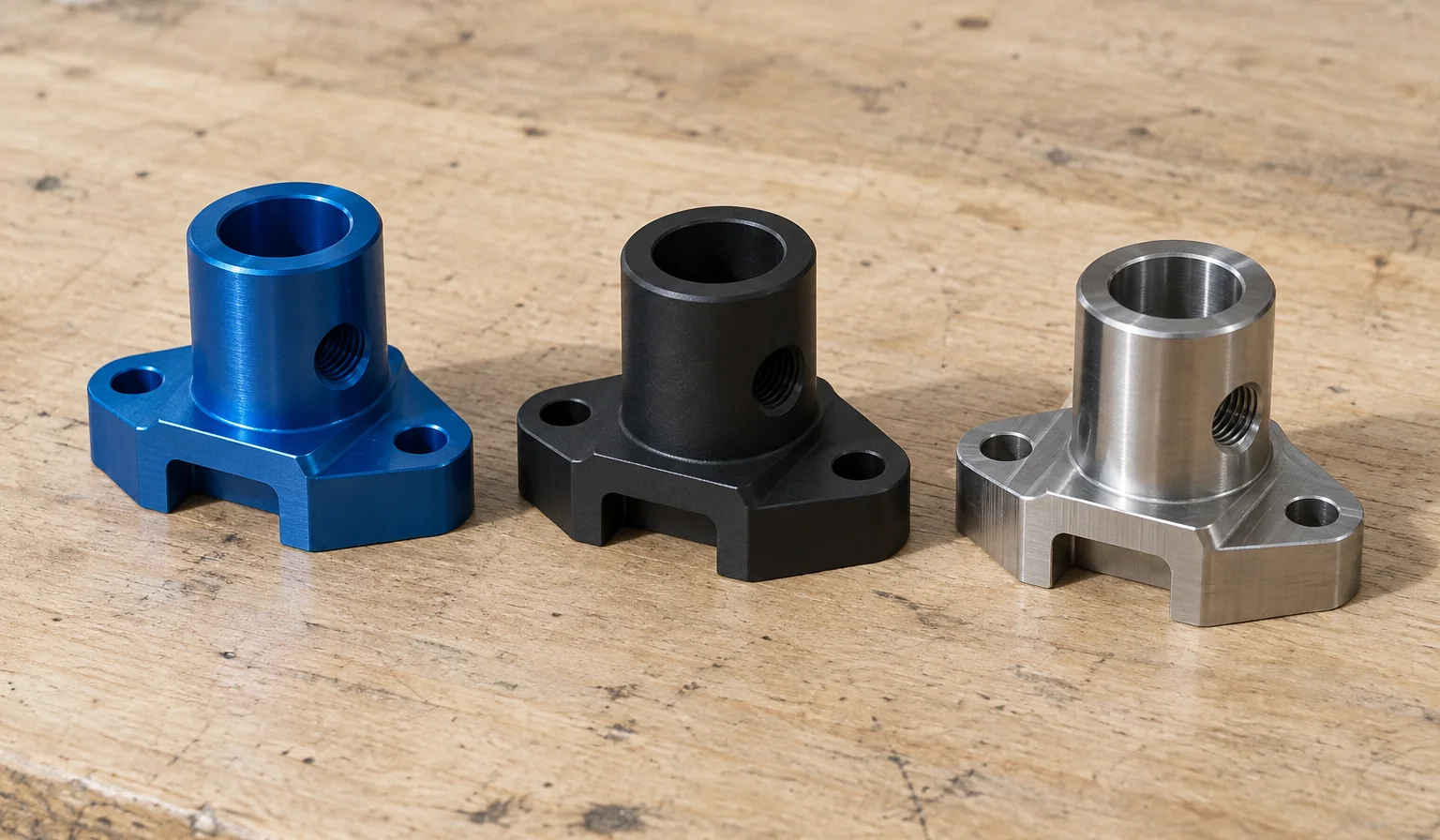
The first question about a finish callout isn't which one performs best. It's which ones your material allows. Anodizing works on aluminum and nothing else. Passivation applies to stainless and nothing else. Powder coating works on both. Half the time the material on the drawing has already eliminated an option before durability enters the conversation.
Anodizing — Aluminum Only, Type II vs Type III
Anodizing doesn't add a layer on top of the part. It converts the surface itself, treating the aluminum electrolytically in a sulfuric acid bath to grow a hard oxide layer out of the parent metal.
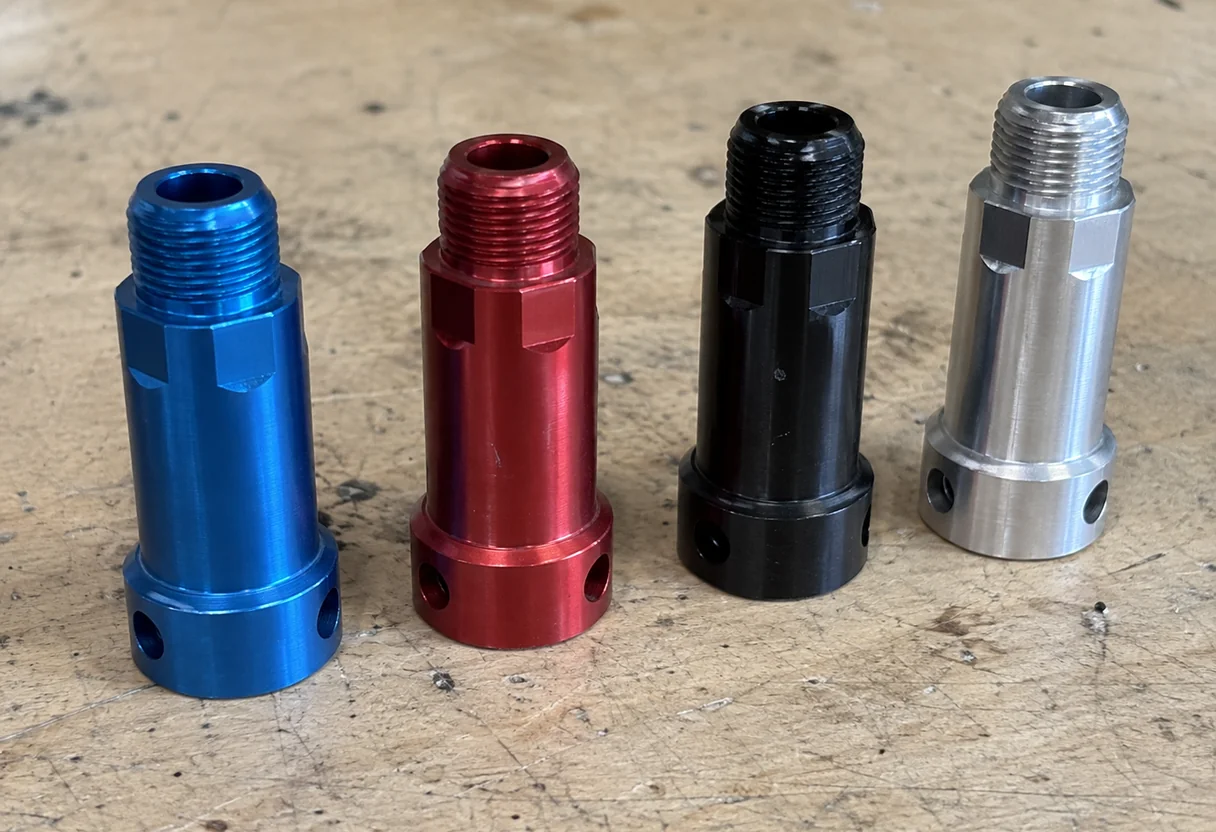
Type II is the standard decorative anodize and the one to specify when the part needs color — dye is absorbed into the porous oxide before sealing. Type III, or hardcoat, is the same process pushed to a heavier, denser coating, nominally 2 mil (50 µm), and specified when abrasion resistance matters more than appearance.
Two constraints catch buyers out. First, anodizing changes your part's dimensions — growth is roughly half the coating thickness, because the layer grows both into and out of the original surface. On a hardcoat part with tight-fitting features that is not a rounding error. Second, hardcoat isn't available on every alloy: Type III is generally not applied to aluminum above about 5% copper or 8% silicon.
Powder Coating — Aluminum or Steel, Cosmetic and Protective
Powder coating is a true coating applied on top. Dry powder is electrostatically charged at the gun, attracted to the grounded part, then cured under heat — typically 5 to 30 minutes at 140–200 °C — where it melts and fuses into a continuous film.
The electrostatic step self-levels: as powder builds up it insulates what it has covered, pushing incoming powder to the bare spots. That, plus wrap-around onto edges and back faces, keeps coverage even on awkward geometry.
It is far thicker than anodizing. Normal powder processes lay down 40–150 µm, which protects well but builds up unevenly enough to interfere with tight tolerances and mating faces — mask those surfaces or leave stock for them. It is also the most material-flexible of the three, with the widest color range.
Passivation — Stainless Only, Function Over Appearance
Passivation isn't cosmetic at all. It is a chemical treatment that removes free iron from a stainless surface and lets the natural chromium-oxide passive film reform underneath.
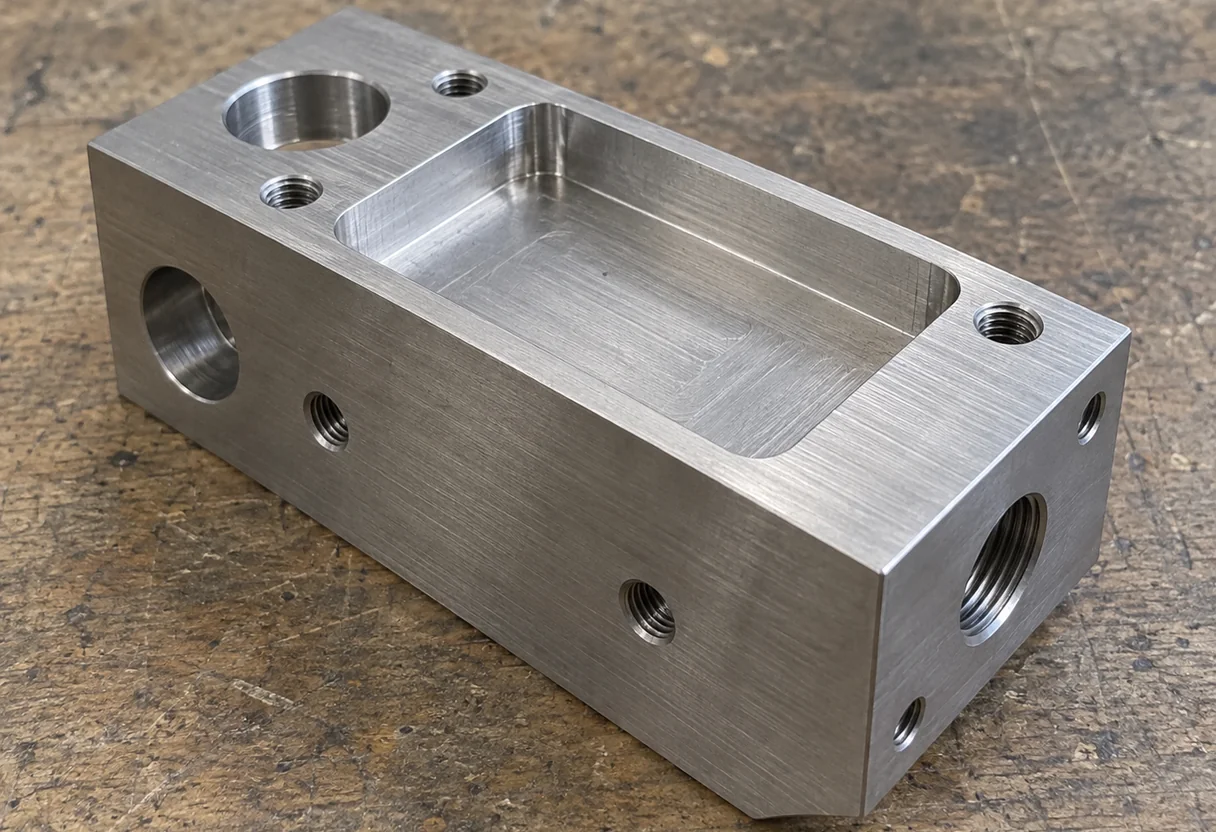
The problem it solves is specific to machined parts. During machining, grinding, blasting and tumbling, iron particles from the tooling get embedded or smeared into the stainless surface. Left there, that iron corrodes and raises rust-like spots on a part that is supposedly stainless. Passivation dissolves it — commonly in nitric acid, per the treatments in ASTM A380 — without touching the stainless itself.
Because nothing is added, it changes neither appearance nor dimensions: no color option, no measurable thickness. It is a common requirement on medical and food-contact parts. See our stainless and aluminum grades.
Cost, Durability and Material Fit — Side by Side
| Anodizing (Type II / III) | Powder Coating | Passivation | |
|---|---|---|---|
| Applicable materials | Aluminum only | Aluminum, steel, most metals | Stainless steel only |
| What it does | Converts the surface into a hard oxide layer | Applies a cured coating on top | Removes free iron, restores the chromium-oxide layer |
| Typical thickness | Type III nominally 50 µm | 40–150 µm | None — no added layer |
| Effect on dimensions | Grows ~half the coating thickness | Adds 40–150 µm, unevenly | None |
| Color options | Yes, dyed | Yes, wide range | No — functional only |
| Relative cost tier (2026) | Low–moderate (Type II); moderate–high (Type III) | Low–moderate | Low |
| Primary benefit | Wear resistance (Type III) or color plus mild corrosion resistance (Type II) | Impact and chip resistance plus cosmetic finish | Corrosion resistance with no dimensional or cosmetic change |
Cost tiers are relative, not quotes — finishing price moves more with masking complexity and part geometry than with the process itself. Our surface finishing services page covers what we run in-house.
Which Finish Fits Your Part?
- Aluminum, needs color or a cosmetic finish → anodizing, Type II
- Aluminum, needs wear resistance over appearance → anodizing, Type III hardcoat
- Aluminum or steel, needs color and impact resistance, cost-sensitive → powder coating
- Stainless, needs corrosion resistance, no color → passivation
Which is more durable depends on the failure mode. Hardcoat anodize wins on abrasion because the hardness is in the metal surface itself. Powder coating wins on impact and chipping, because a thick polymer film absorbs a knock that would crack a brittle oxide layer.
What This Means for Your Next Quote
Naming the finish isn't enough. Say which surfaces get it and which don't — masking a cosmetic face, a mating surface or a threaded hole is a separate line item with its own lead time, and it is the detail most often missing from a drawing. Check finish thickness against any tight-tolerance feature too, since two of these three change the part's size. Scope your finishing requirements with our team before the drawing is released — contact us with your drawing and material, or explore our surface finishing and metal materials pages.