Stainless doesn't cut like aluminum or mild steel. It work-hardens under the tool, holds heat at the cutting edge, and wears tooling faster than either. So the method isn't a shop preference — it's set by stock form and the tolerances the part must hold. Four processes cover almost every production stainless part.
Why Stainless Cuts Differently Than Aluminum or Mild Steel
It work-hardens as you cut it. Austenitic grades like 304 and 316 harden in the deformed layer just ahead of the tool. Anything that rubs instead of cutting — too light a feed, a dwell at the end of a pass, a dull edge — glazes that surface and leaves the next pass cutting harder material.
It holds heat. Austenitic stainless has roughly three times lower thermal conductivity than plain carbon steel, so cutting heat concentrates at the tool interface instead of leaving with the chip, and shortens tool life.
It sticks to the tool. Chips weld to the rake face, and when that built-up edge breaks away it can carry a fragment of the tool with it — which is why stainless tool life is erratic rather than gradually declining, and why it dulls tooling faster than aluminum does.
Grade matters as much as process: published turning data puts free-machining 303 roughly 40% faster than 316 at equal hardness, and hardened 17-4PH slower again. See our stainless and other metal grades.
CNC Turning — For Round, Bar-Stock Parts
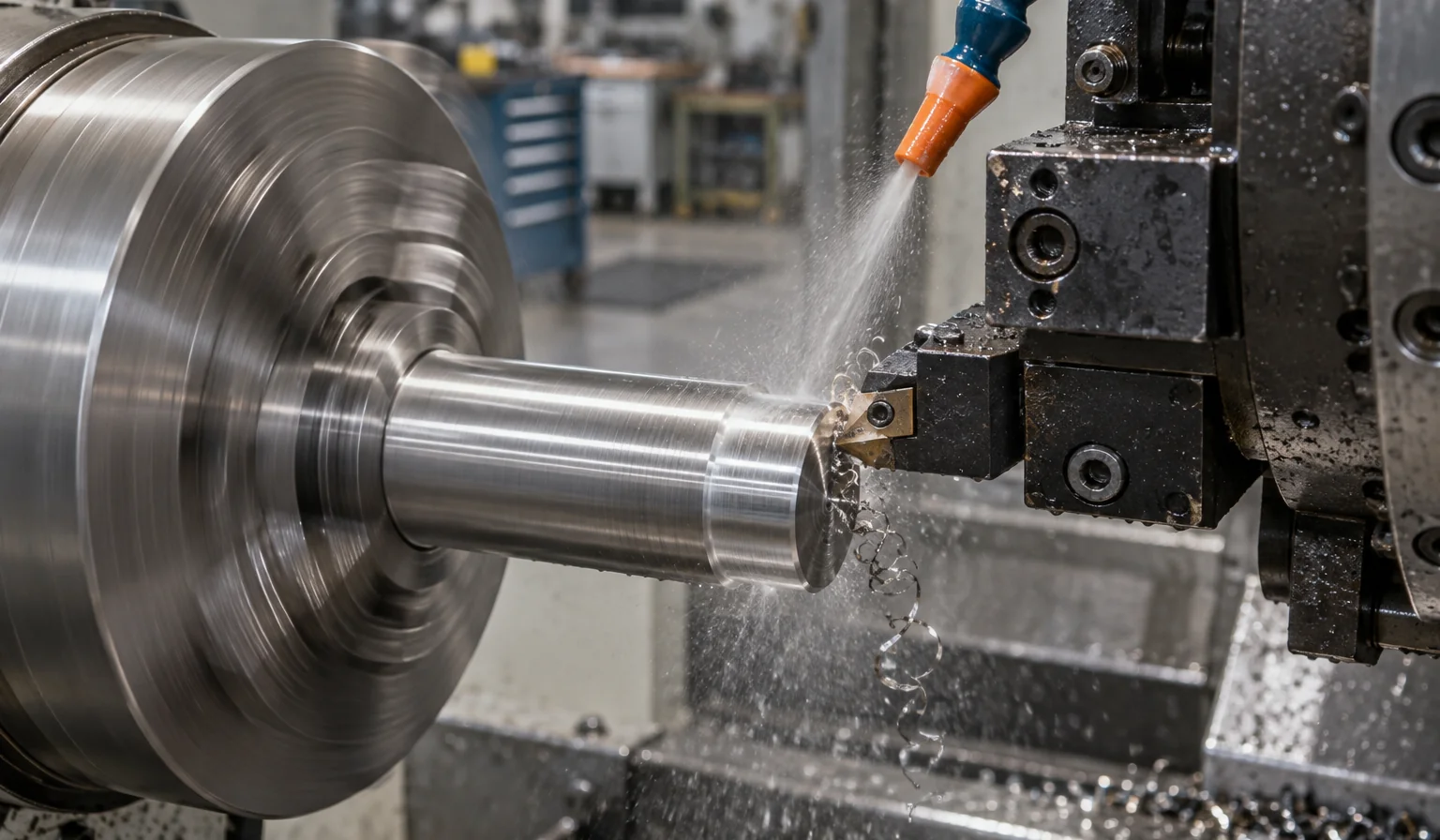
Turning handles anything rotationally symmetric cut from bar: shafts, sleeves, spacers, bushings, threaded fittings, valve bodies. It runs at lower surface speed and heavier feed per revolution than the same part in aluminum — the heavier feed is deliberate, keeping the insert cutting beneath the work-hardened layer instead of burnishing on top of it.
Best fit: round parts controlled by diameter, concentricity and runout. CNC turning with live tooling also cuts cross-holes and flats in the same setup, avoiding a second datum.
CNC Milling — For Prismatic, Non-Round Parts
Milling covers what turning can't: brackets, housings, manifolds, and blocks with pockets, bores and machined faces.
Rigidity matters more here than on any other common shop material. Standard guidance for stainless is blunt about it — the machine must be sturdy, adequately powered and free from vibration, and the edge kept sharp, because dull tools glaze and work-harden the surface. On thin walls, deflection under load shows up as tolerance drift rather than visible chatter.
Best fit: parts needing several features in one setup, especially when faces must hold position to each other — every extra CNC milling setup adds a stack-up.
Laser Cutting — For Thin-to-Mid Gauge Sheet
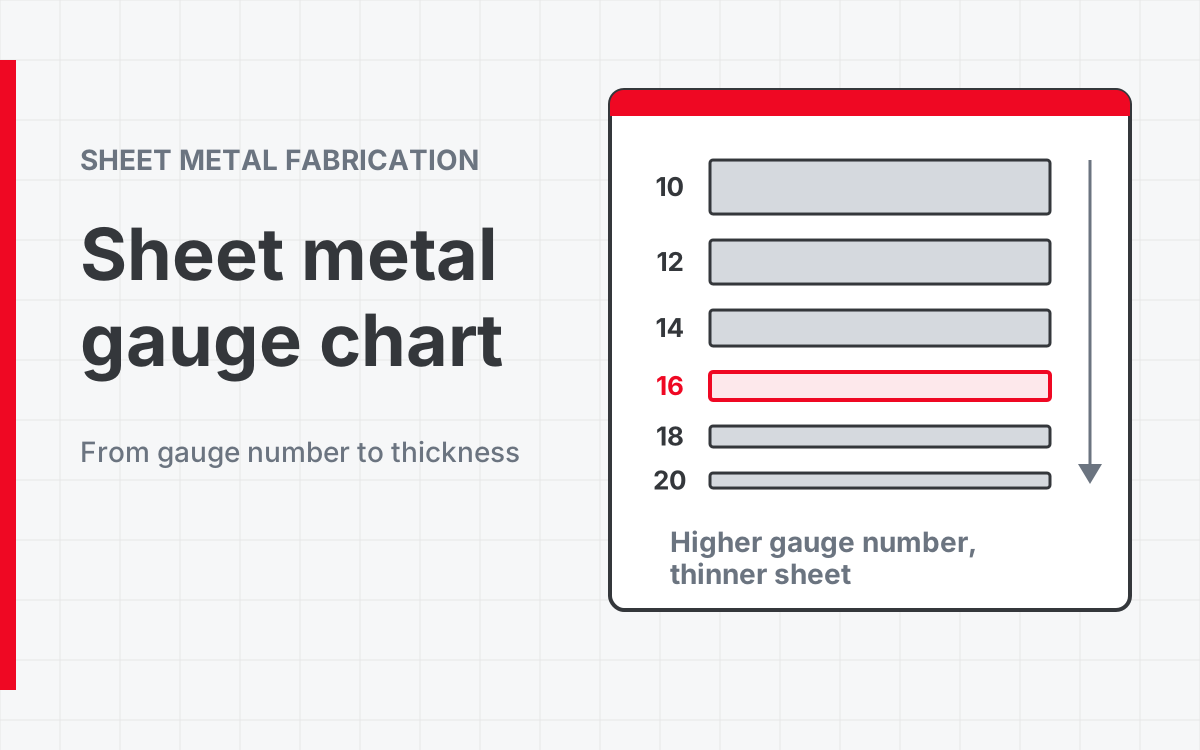
Yes, stainless laser cuts well — it's the default for flat parts up to roughly 1/2 inch (12.7 mm), with the ceiling set by machine power.
What matters is how sharply speed falls off with thickness. Published feed rates for a 4 kW fiber laser on stainless run about 1,456 in/min at 1 mm, 138 in/min at 6.4 mm and 39 in/min at 12.7 mm — a roughly 37-fold collapse. That curve, not a hard cutoff, is why laser stops being economical at mid gauge.
Stainless is normally cut with nitrogen assist, which leaves an oxide-free edge ready to weld or paint at the cost of speed. The heat-affected zone is real but narrow.
Best fit: 2D flat patterns cut before bending — brackets, panels, chassis, enclosure cutouts.
Waterjet Cutting — For Thick Plate or Heat-Sensitive Geometry
Abrasive waterjet is the only one of these four with no heat-affected zone at all. In Machinery's Handbook's comparison of nontraditional cutting methods, the HAZ row reads "None" for waterjet against "Narrow Zone" for laser and "Yes" for plasma. It cuts stainless past 100 mm without changing the metallurgical structure at the cut face.
The trade is speed: 12.7 mm stainless cuts at about 4 in/min by waterjet against 39 by laser. But waterjet degrades far more gently with thickness (roughly 75, 11 and 4 in/min at 1, 6.4 and 12.7 mm), so the gap narrows and reverses on heavy plate. It also bevels thick sections and rarely pays on thin gauge. Where a HAZ and dross are acceptable, plasma is the volume option around 25 mm plate.
Best fit: plate too thick for laser, and parts where no HAZ is a requirement, not a preference.
Which Method Fits Your Part?
- Round part from bar stock → CNC turning
- Non-round part needing multiple machined features → CNC milling
- Flat sheet, thin-to-mid gauge, 2D profile → laser cutting
- Thick plate, or HAZ and distortion unacceptable → waterjet cutting
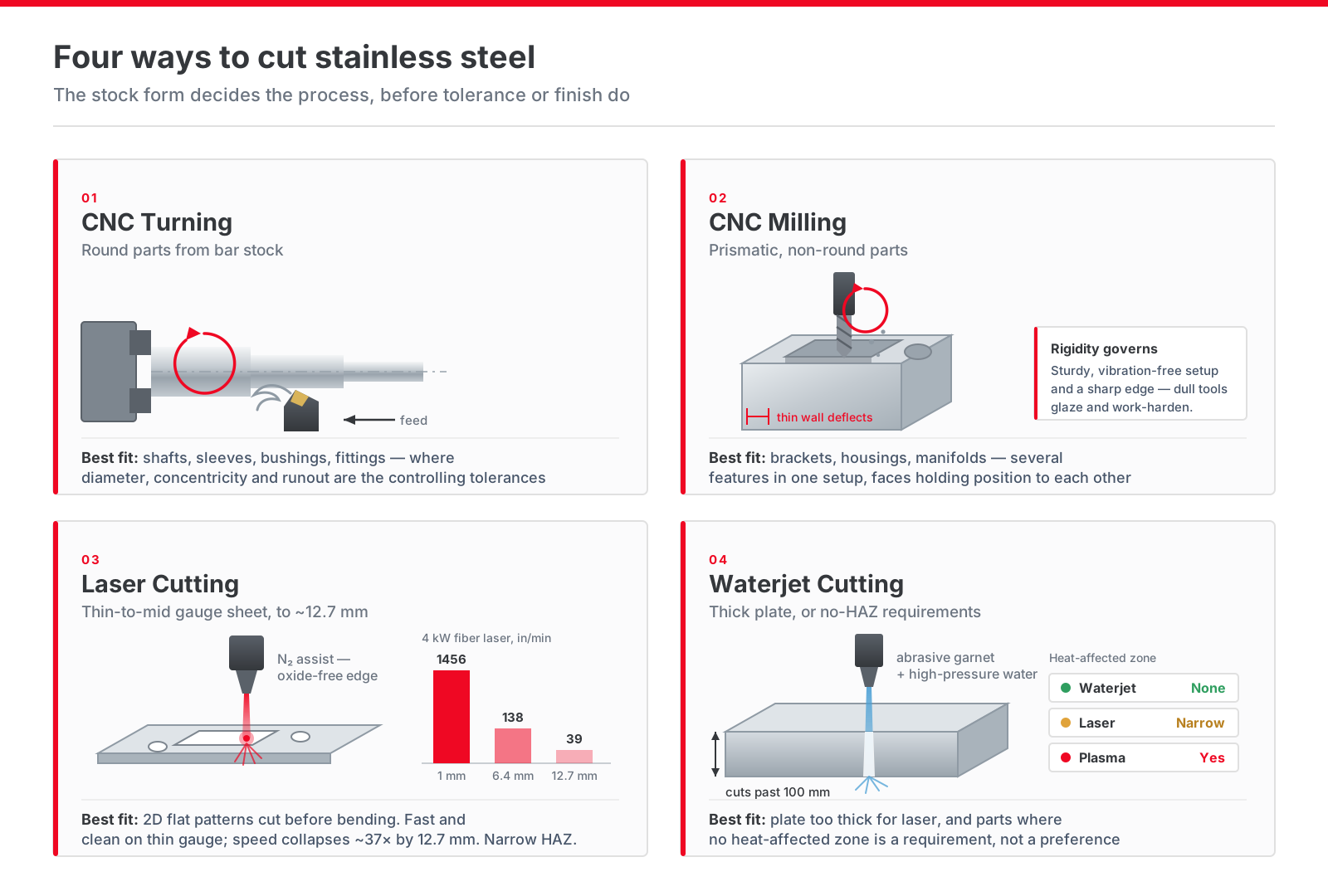
Geometry and stock form set the choice; tolerance and finish refine it.
What This Means for Your Next Quote
Specify three things and the process selects itself: stock form (sheet gauge, bar diameter or plate thickness), grade (304 vs. 316 vs. 17-4PH), and which tolerances are critical. Without them a shop must assume a process before it can price anything. Get a quote on your stainless part by sending the drawing with those three details. See our CNC turning, CNC milling and metal materials pages, or contact us with your drawing and grade.